“content”:”
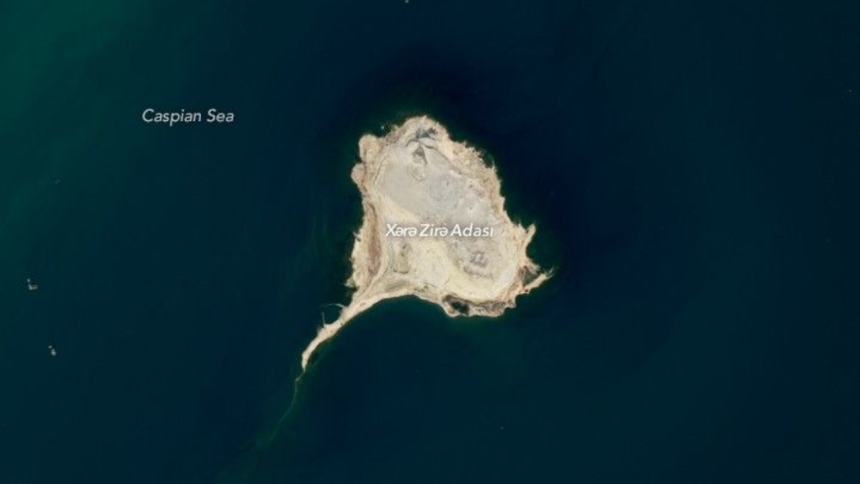
The vast and ancient Caspian Sea, nestled between Europe and Asia, has long been a source of fascination for scientists and adventurers alike. Its waters hide secrets of the Earth’s past, including a peculiar and enigmatic geological phenomenon that has captured the imagination of experts worldwide. Recently, NASA has shed light on the mysterious mud volcano islands of Azerbaijan, a natural wonder that has been brewing beneath the surface for millennia.
Geological Marvels: The Birth of Mud Volcano Islands
The Caspian Sea’s unique combination of tectonic activity, sedimentation, and groundwater flow has given rise to a series of mud volcanoes that have been erupting for thousands of years. These underwater volcanoes, also known as mud domes, are formed when methane and other gases become trapped beneath the seabed, causing the mud to rise and create conical structures. Over time, these mud volcanoes have grown and merged, eventually forming a chain of islands that protrude from the Caspian’s surface.
Studies have shown that these mud volcanoes are not just random formations but are rather connected to a vast network of underground caverns and channels. This subterranean system allows the mud to flow and accumulate, creating new islands and reshaping the existing landscape. The mud itself is a complex mixture of clay, silt, and water, which has been infused with minerals and other substances as it interacts with the surrounding rock and water. As a result, the mud volcanoes possess unique chemical signatures that can provide valuable insights into the Earth’s history and the processes that have shaped our planet.
The Science Behind the Islands’ Formation
NASA’s involvement in studying the mud volcano islands has provided a wealth of information on their geological history. By combining data from satellite imagery, seafloor mapping, and field observations, scientists have been able to reconstruct the islands’ formation over millions of years. This research has revealed the complex interplay between tectonic forces, sedimentation, and groundwater flow that has created this remarkable landscape.
One of the key findings is that the mud volcanoes are not static features but are constantly evolving. New islands are formed as mud flows from the surrounding seabed, while existing ones are reshaped by the ongoing process of sedimentation and erosion. This dynamic nature of the mud volcanoes has important implications for our understanding of the Earth’s geology and the processes that shape our planet’s surface.
Conservation and Exploration: The Future of Azerbaijan’s Mud Volcano Islands
As the world becomes increasingly aware of the significance of these enigmatic islands, conservation efforts are underway to protect this unique ecosystem. The Azerbaijan government has established a protected area around the islands, which will help to safeguard the delicate balance of the ecosystem and prevent human activities from disrupting the natural processes.
Despite the challenges, scientists and explorers continue to be drawn to the mud volcano islands. New technologies and research methods are being developed to further our understanding of this fascinating landscape. By studying the mud volcanoes and their interactions with the surrounding environment, scientists hope to gain insights into the Earth’s past and the underlying mechanisms that have shaped our planet. The future of Azerbaijan’s mud volcano islands holds much promise for scientific discovery and exploration.
As we continue to unravel the secrets of these enigmatic islands, we are reminded of the awe-inspiring complexity and beauty of the Earth’s natural world. The mud volcano islands of Azerbaijan are a testament to the incredible diversity of geological formations that can be found on our planet and serve as a reminder of the importance of continued exploration and scientific inquiry.
“,
“excerpt”:”NASA reveals a previously unknown geological phenomenon in Azerbaijan, where mud volcanoes have been erupting for thousands of years, creating a chain of islands in the Caspian Sea.”,
“tags”:[“science”,”geology”,”environment”,”conservation”,”NASA”,”Azerbaijan”,”Caspian Sea”,”mud volcanoes”,”islands”,”ecosystem”,”protected area”,”research”,”exploration”],
“meta_description”:”NASA’s study of Azerbaijan’s mud volcano islands reveals a complex geological phenomenon that has been brewing for millennia, with ongoing implications for our understanding of the Earth’s history and processes.”}