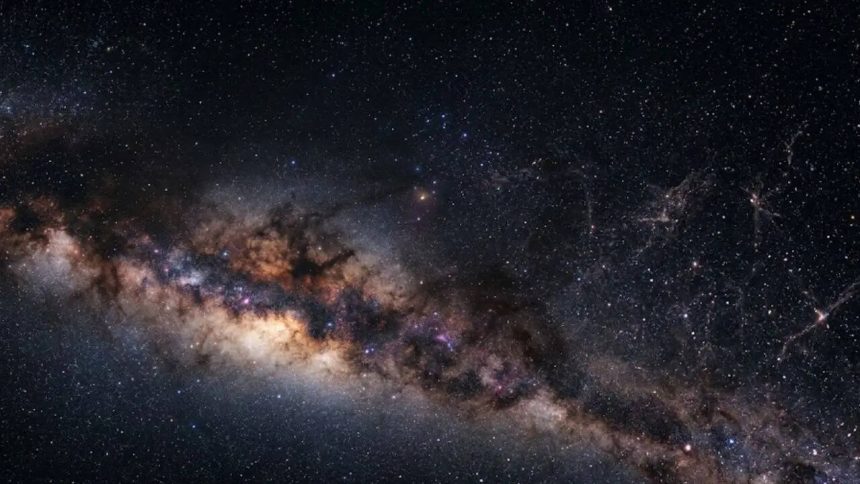
Astronomers have long been fascinated by the vast expanse of the universe, and the mysteries that lie beyond our galaxy, the Milky Way. For decades, scientists have been trying to map the distribution of matter and energy in the universe, but one region has remained elusive – the area behind the Milky Way. This ‘hidden’ structure, spanning millions of light-years, has finally been mapped by a team of international astronomers, revealing a complex network of galaxies, galaxy clusters, and superclusters that challenge our current understanding of the cosmos.
Mapping the Unseen
The team, led by astronomers from the University of Cape Town, used sophisticated computer simulations and observational data from various telescopes to create a detailed map of the region. By analyzing the distribution of galaxies and galaxy clusters, they were able to reconstruct the underlying structure of the universe, revealing a vast network of filaments and voids that crisscross the cosmos. This map provides a unique glimpse into the large-scale structure of the universe, and has significant implications for our understanding of the formation and evolution of galaxies.
The mapping process was a complex and challenging task, requiring the development of new algorithms and computational techniques to analyze the vast amounts of data collected. The team used a combination of optical, infrared, and radio telescopes to observe the region, and then used computer simulations to model the distribution of matter and energy. The resulting map is a testament to the power of international collaboration and the cutting-edge technology used in modern astronomy.
Understanding the Cosmic Web
The mapped structure behind the Milky Way is part of a larger network of galaxy filaments and voids that stretch across the universe, forming a complex web-like structure. This ‘cosmic web’ is thought to have formed in the early universe, as matter began to clump together under the influence of gravity. The team’s findings suggest that this web is more complex and dynamic than previously thought, with galaxies and galaxy clusters moving along the filaments and interacting with each other in complex ways.
The discovery of this hidden structure has significant implications for our understanding of the universe, and raises new questions about the formation and evolution of galaxies. For example, how did the Milky Way form and evolve within this larger structure? How do galaxies interact with each other, and what role do supermassive black holes play in shaping the cosmic web? The team’s findings provide a new framework for addressing these questions, and will likely inspire a new generation of astronomers to study the universe in unprecedented detail.
Implications and Future Directions
The mapping of the hidden structure behind the Milky Way is a major breakthrough in astronomy, and has significant implications for our understanding of the universe. The findings will be used to refine models of galaxy formation and evolution, and will provide a new framework for studying the large-scale structure of the universe. The team’s work also highlights the importance of international collaboration in astronomy, and demonstrates the power of cutting-edge technology in advancing our understanding of the cosmos.
As astronomers continue to study the universe in unprecedented detail, we can expect to uncover even more secrets and surprises. The mapping of the hidden structure behind the Milky Way is a significant step forward in our understanding of the cosmos, and will likely inspire new generations of astronomers to explore the universe and uncover its secrets. With ongoing and future surveys, such as the Square Kilometre Array, we can expect to gain even more insight into the workings of the universe, and to continue to push the boundaries of human knowledge and understanding.