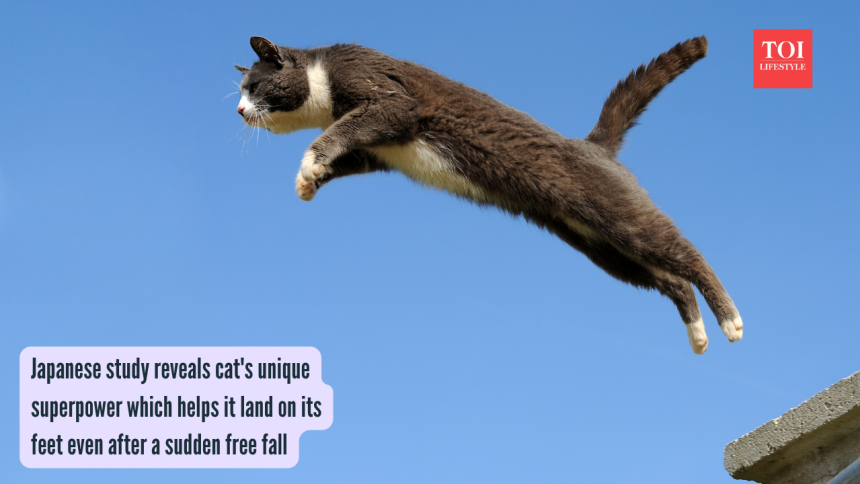
Cats have long been known for their agility and flexibility, but a recent Japanese study has shed new light on the remarkable ability of these animals to land on their feet even after a sudden free fall. This phenomenon, often referred to as a cat’s ‘righting reflex,’ has fascinated scientists and animal lovers alike for centuries. The study, which used high-speed cameras to capture the movements of cats in mid-air, reveals the unique physical characteristics and clever tactics that enable cats to navigate a fall with ease and precision.
The Science of Righting Reflex
The researchers found that cats have an incredibly flexible spine, which allows them to twist and turn their bodies in mid-air with remarkable speed and agility. This flexibility, combined with their acute sense of balance and spatial awareness, enables cats to make the necessary adjustments to their body position in a split second. The study also revealed that cats use their ears and tail to help them balance and orient themselves during a fall, making tiny adjustments to their movements to ensure a safe landing.
One of the most interesting findings of the study was the discovery that cats are able to rotate their bodies in mid-air, using a unique motion that involves the movement of their spine, legs, and tail. This rotation, which can be as much as 180 degrees, allows cats to position themselves for a safe landing, even when they are falling upside down. The researchers were able to capture this motion on film, using high-speed cameras that recorded the cats’ movements at speeds of up to 1,000 frames per second.
Understanding the Physics of Feline Falls
The study also explored the physics behind a cat’s fall, revealing the complex interplay of forces that come into play when a cat is in mid-air. The researchers found that cats use a combination of angular momentum and torque to rotate their bodies, generating a force that allows them to overcome the effects of gravity and land on their feet. This force, which is created by the movement of the cat’s legs and tail, is strong enough to counteract the downward pull of gravity, enabling the cat to make a safe landing.
The study’s findings have significant implications for our understanding of animal physiology and the physics of movement. By studying the unique characteristics and abilities of cats, scientists can gain a deeper understanding of the complex interactions between an animal’s body and its environment, and how these interactions enable animals to navigate and survive in a wide range of situations. The research also has the potential to inform the development of new technologies, such as robotic systems that can mimic the movements and agility of cats.
Implications and Applications
The discovery of the secret to cats’ gravity-defying falls has sparked widespread interest and excitement, with many scientists and animal lovers eager to learn more about the remarkable abilities of these animals. The study’s findings have also raised questions about the potential applications of this research, from the development of new robotic systems to the creation of more effective safety devices for humans. As scientists continue to explore the fascinating world of animal physiology and movement, it is likely that we will uncover even more secrets about the remarkable abilities of cats and other animals.
As we marvel at the incredible agility and flexibility of cats, we are reminded of the awe-inspiring complexity and beauty of the natural world. The study of animal movement and physiology is a fascinating and rapidly evolving field, with new discoveries and advancements being made all the time. As we continue to explore and learn more about the remarkable abilities of cats and other animals, we are inspired by the incredible diversity and adaptability of life on Earth, and the many secrets that still remain to be uncovered.