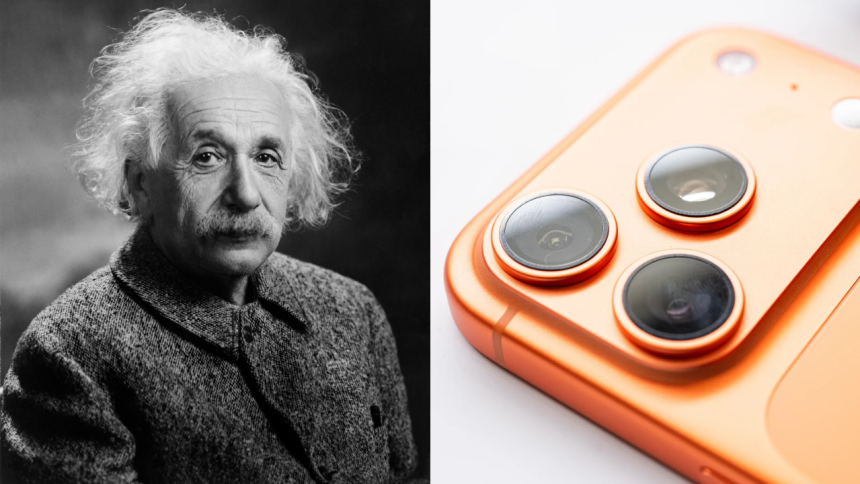
The next time you snap a photo with your smartphone, take a moment to appreciate the incredible science behind the camera lens. At the heart of this technology lies a concept that was once considered radical and even bizarre: the idea that light can behave as both a wave and a stream of tiny particles. This notion, first proposed by Albert Einstein over a century ago, has had a profound impact on our understanding of the physical world and has led to the development of countless innovative technologies, including the smartphone camera.
The Birth of a Revolutionary Idea
In 1905, Einstein introduced the concept of wave-particle duality, which suggested that light can exhibit both wave-like and particle-like behavior depending on how it is observed. This idea was met with skepticism by many of Einstein’s contemporaries, who struggled to accept that light could be both a continuous wave and a stream of discrete particles, now known as photons. Despite the initial backlash, Einstein’s theory eventually gained widespread acceptance and paved the way for major breakthroughs in fields such as quantum mechanics and electronics.
Einstein’s work on the photoelectric effect, which demonstrated that light can eject electrons from metal surfaces, provided further evidence for the particle-like nature of light. This discovery not only earned Einstein the Nobel Prize in Physics in 1921 but also laid the foundation for the development of modern technologies such as solar cells, image sensors, and digital cameras. The photoelectric effect is still a crucial component of many electronic devices, including the camera in your smartphone, which relies on the ability of light to interact with electronic sensors and produce an image.
From Theory to Practice
The impact of Einstein’s idea can be seen in the way that smartphone cameras capture and process images. The camera’s image sensor, which converts light into electrical signals, relies on the photoelectric effect to produce a digital image. When light enters the camera lens, it strikes the image sensor, causing electrons to be released and creating an electrical signal that is then processed and stored as a digital image. This process is made possible by the unique properties of light, which can behave as both a wave and a particle, allowing it to interact with the image sensor and produce a high-quality image.
The development of smartphone cameras has also been driven by advances in materials science and electronics. The creation of smaller, more efficient image sensors and the development of advanced image processing algorithms have enabled smartphone cameras to produce high-quality images that rival those of traditional digital cameras. As a result, smartphone cameras have become an essential part of modern life, used for everything from taking selfies and recording videos to scanning documents and capturing memories.
A Lasting Legacy
Today, Einstein’s idea of wave-particle duality remains a fundamental concept in physics and has far-reaching implications for our understanding of the universe. The technology that has been developed as a result of this idea, including smartphone cameras, has transformed the way we live, work, and communicate. As we continue to push the boundaries of innovation and develop new technologies, we owe a debt of gratitude to Einstein and his groundbreaking work, which has inspired generations of scientists and engineers to explore the mysteries of the physical world.
The next time you use your smartphone camera, remember the incredible science behind the lens and the pioneering work of Albert Einstein, who dared to challenge conventional wisdom and propose a radical new idea that has had a lasting impact on our world. His legacy serves as a reminder of the power of human curiosity and the importance of pursuing bold and innovative ideas, no matter how strange or unconventional they may seem.