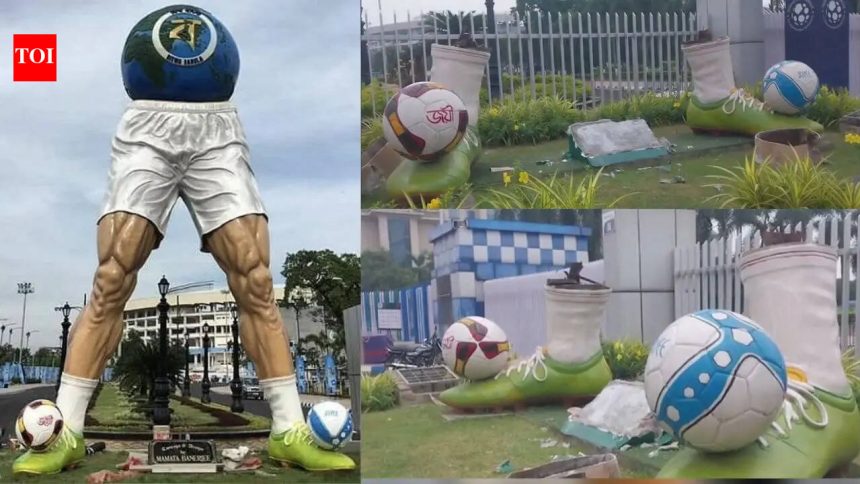
The Salt Lake Stadium, a venue that has witnessed countless moments of sporting glory, was at the center of a controversy recently. The West Bengal government’s decision to remove a football-themed sculpture, designed by none other than former Chief Minister Mamata Banerjee, has sparked a heated debate. The sculpture, which was installed outside the stadium, was taken down on Saturday, leaving many to wonder about the reasoning behind this move. The sculpture, a brainchild of Banerjee, was meant to be a symbol of the state’s love for football, but it ultimately became a subject of controversy, with many questioning its aesthetic appeal and the cost involved in its installation.
Background of the Sculpture
The sculpture, which was unveiled a few years ago, was meant to be a tribute to the beautiful game and the state’s rich football heritage. Banerjee, known for her passion for football, had envisioned the sculpture as a way to promote the sport and inspire young players. However, the sculpture failed to impress many, with some criticizing its design and others questioning the allocation of funds for the project. Despite the controversy, the sculpture had become a recognizable landmark outside the Salt Lake Stadium, and its removal has left a void of sorts.
The removal of the sculpture has also raised questions about the state government’s priorities and its approach towards public art. While some have welcomed the move, citing the need to focus on more pressing issues, others have expressed disappointment, arguing that the sculpture was a unique aspect of the city’s landscape. As the debate rages on, it remains to be seen how the state government plans to utilize the space where the sculpture once stood.
Reactions and Implications
The removal of the sculpture has elicited strong reactions from various quarters, with some hailing the move as a step in the right direction and others condemning it as a politically motivated decision. Political analysts believe that the move could be a strategic attempt by the current government to distance itself from the previous regime and its legacy. On the other hand, football enthusiasts have expressed sadness at the loss of a symbol that represented the state’s passion for the sport.
As the news of the sculpture’s removal spreads, many are left wondering about the fate of other public art installations in the city. Will this move set a precedent for the removal of other controversial artworks, or will it be an isolated incident? Only time will tell, but one thing is certain – the removal of the football sculpture has sparked a conversation about the role of public art in our cities and the need for a more nuanced approach towards its installation and maintenance.
Future of Public Art in Bengal
The removal of the sculpture has also raised important questions about the future of public art in Bengal. As the state government navigates the complex landscape of artistic expression and public opinion, it must balance the need to promote creativity and self-expression with the need to ensure that public art is inclusive, accessible, and respectful of diverse perspectives. The decision to remove the sculpture may be seen as a setback for public art in the state, but it also presents an opportunity for the government to engage with artists, citizens, and stakeholders to create a more vibrant and inclusive cultural landscape.
The Salt Lake Stadium, once again, finds itself at the center of attention, but this time, it is not about the beautiful game, but about the complexities of public art and the role of government in shaping our cultural heritage. As the city moves forward, it is essential to remember that public art has the power to inspire, to educate, and to bring people together. The removal of the football sculpture may be a loss, but it can also be a catalyst for a more informed and nuanced discussion about the importance of public art in our lives.