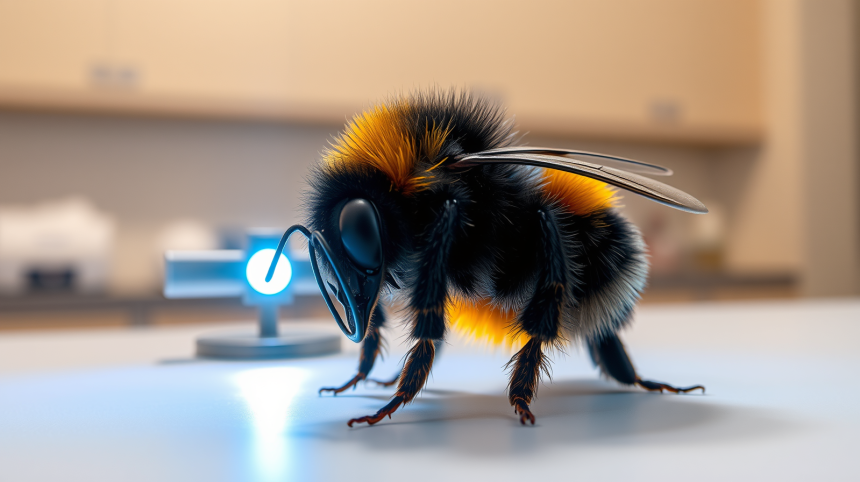
In a groundbreaking discovery that challenges long-held assumptions about the cognitive abilities of insects, researchers at Queen Mary University of London have found that buff-tailed bumblebees possess an uncanny capacity to distinguish between different lengths of light flashes. This remarkable skill, previously thought exclusive to humans and a select group of vertebrates, has left scientists stunned and eager to unravel the secrets behind the bees’ remarkable timing abilities. For years, researchers have believed that only a handful of animals, including humans, dolphins, and some species of birds, possess the cognitive machinery necessary to perceive and interpret the duration of light and darkness.
Unraveling the Mystery of Bumblebee Perception
At the heart of the researchers’ study lies an intriguing question: how do bumblebees manage to perceive and interpret the duration of light flashes, a skill that has long been considered the exclusive domain of higher-level cognitive processes? To answer this question, the researchers employed a unique experimental design, where they presented bumblebees with a series of light flashes of varying durations, ranging from a few milliseconds to several seconds. The results were nothing short of astonishing: the bumblebees were able to accurately distinguish between the different lengths of light flashes, a feat that has left scientists scrambling to understand the underlying mechanisms.
One of the key insights to emerge from the study is the remarkable sensitivity of the bumblebees’ visual system. The researchers found that the bees were able to detect even the slightest variations in light intensity, allowing them to perceive the duration of the light flashes with remarkable accuracy. This sensitivity is all the more impressive given the fact that bumblebees have relatively simple eyes compared to other animals, and their visual system is thought to be optimized for detecting movement and detecting the location of flowers.
The Implications of Bumblebee Intelligence
The implications of this study are far-reaching and have significant implications for our understanding of insect cognition. For years, scientists have believed that insects were limited to a relatively simple form of intelligence, one that was centered around basic survival instincts such as finding food and avoiding predators. However, the discovery of the bumblebees’ timing abilities challenges this assumption and suggests that insects may be capable of more complex forms of cognition than previously thought.
The study also raises important questions about the evolution of intelligence in animals. How did bumblebees develop the ability to perceive and interpret the duration of light flashes? Was this ability developed in response to specific environmental pressures or did it emerge as a byproduct of other cognitive processes? These are just a few of the many questions that remain to be answered, and the study serves as a timely reminder of the importance of continued research into the complexities of animal cognition.
The Future of Bumblebee Research
As researchers continue to unravel the secrets behind the bumblebees’ timing abilities, it is clear that this study marks the beginning of a new era in bumblebee research. The discovery of this remarkable skill has opened up new avenues of inquiry and has challenged long-held assumptions about the cognitive abilities of insects. With continued research and experimentation, it is likely that we will uncover even more fascinating insights into the world of insect cognition.
For now, the bumblebees remain an enigma, their remarkable timing abilities a testament to the incredible diversity and complexity of animal cognition. As we continue to explore the mysteries of the natural world, it is clear that there is still much to be discovered and much to be learned from these incredible creatures.