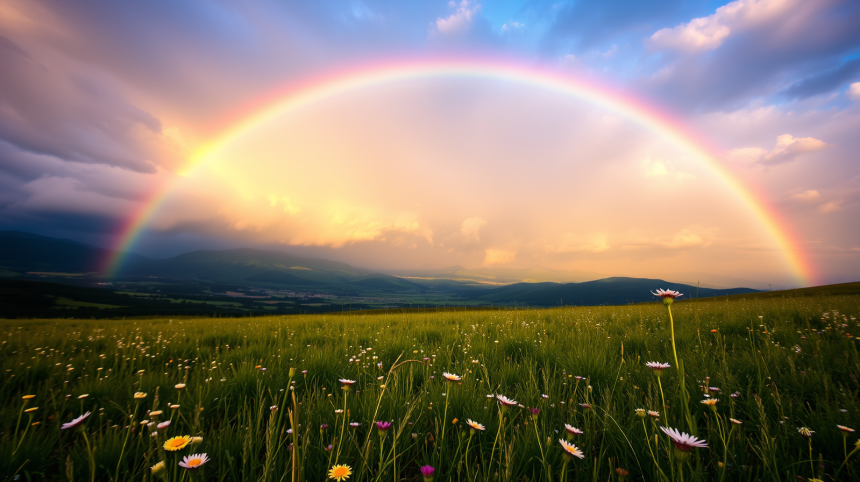
The next time you spot a rainbow stretching across the sky after a refreshing monsoon shower, take a moment to appreciate the breathtaking sight. The vibrant arc of colors that seems to appear out of nowhere is a natural wonder that has captivated humans for centuries. But have you ever stopped to think that the rainbow you’re seeing is unique to you, and you alone?
It’s a notion that may seem counterintuitive, given the way rainbows appear to be a shared experience for everyone around us. But the science behind rainbows reveals a fascinating paradox: each of us sees a different rainbow, due to the way our brains process light and color. This phenomenon is a testament to the incredible complexity and individuality of human perception.
First Section: The Physics of Rainbows
Rainbows are created when sunlight passes through water droplets in the air, a process known as refraction. As the light is refracted, or bent, it is split into its individual colors, a phenomenon known as dispersion. The different colors then bend at slightly different angles, creating the arc of colors that we see as a rainbow.
But here’s the key point: each of us sees the rainbow from a unique vantage point, with our own individual perspective on the position and orientation of the sun, the water droplets, and our own eyes. This means that the angle at which we see the rainbow, and the way it is refracted and dispersed, is unique to us.
So, what does this mean for our understanding of rainbows? It means that the rainbow we see is not a fixed, objective phenomenon, but rather a subjective experience that is shaped by our individual perspectives. In other words, the rainbow is not a thing in itself, but rather a way of perceiving the world around us.
Second Section: The Psychology of Perception
The science of perception is a complex and multifaceted field, and it’s clear that our brains are wired to process visual information in unique and individual ways. Research has shown that our perception of color, in particular, is highly subjective and influenced by a range of factors, including memory, attention, and past experiences.
When we look at a rainbow, our brains are processing a vast amount of information, from the color and brightness of the different hues to the shape and orientation of the arc itself. And because each of us has a unique set of experiences and expectations, our brains are interpreting that information in different ways, resulting in a unique rainbow experience for each of us.
This raises interesting questions about the nature of reality and our place within it. If each of us sees a different rainbow, does that mean that there is no objective reality, but rather a multitude of subjective experiences that are shaped by our individual perspectives? Or do we see the rainbow as a kind of collective experience, a shared cultural icon that transcends individual differences?
Third Section: The Cultural Significance of Rainbows
Rainbows have long been a source of fascination and inspiration for artists, writers, and musicians. From the vibrant colors of a rainbow to the symbolic meanings attached to different hues, rainbows have been a staple of human culture for centuries.
But what does it mean that each of us sees a unique rainbow? Does it make the rainbow a more personal and intimate experience, one that is tied to our individual experiences and emotions? Or does it make the rainbow a more universal and shared experience, one that transcends individual differences and speaks to a deeper sense of human connection?
Ultimately, the answer to these questions will depend on our individual perspectives and experiences. But one thing is clear: the rainbow paradox is a reminder of the incredible complexity and beauty of human perception, and the unique experiences that each of us brings to the world around us.
So the next time you spot a rainbow, take a moment to appreciate the beauty and wonder of it. And remember, it’s not just a shared experience – it’s a unique one, all your own.