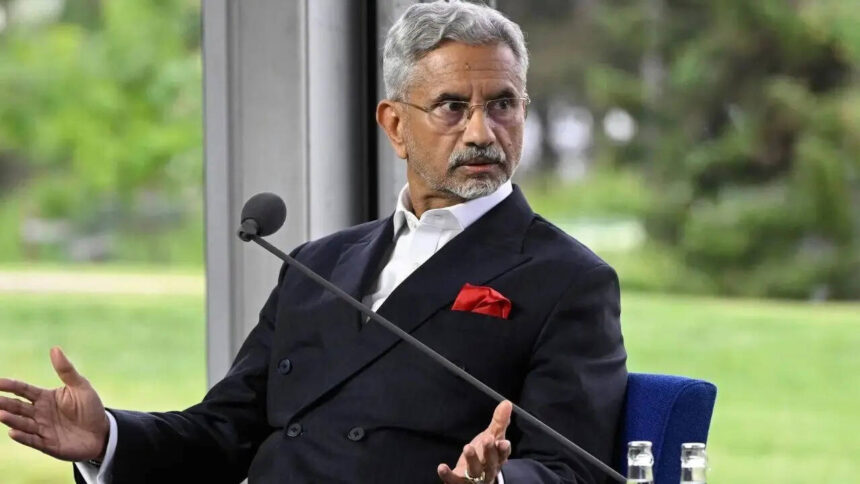
In a scathing critique of the United States’ foreign policy, External Affairs Minister S Jaishankar has called out Washington’s tendency to impose and lift sanctions or tariffs based on its own interests rather than any fixed principle. Speaking at a recent event, Jaishankar took aim at the West’s double standards, saying that they do it when it suits them, leaving many to wonder what exactly constitutes their guiding philosophy on the global stage. The sharp words from India’s top diplomat come as the US and its allies continue to navigate a complex web of relationships with Russia, China, and other key players.
Shifting Stance on Russian Oil
One of the key areas of contention has been the US’s stance on Russian oil, which has been subject to varying degrees of sanction and restriction in recent years. In 2022, the US imposed a ban on Russian oil imports in response to Moscow’s invasion of Ukraine, but this ban has since been lifted, with the White House allowing some exceptions for countries that rely heavily on Russian energy. Jaishankar sees this shift as a clear indication of the US’s willingness to change its stance on Russia when it serves its interests, rather than adhering to any fixed principle of opposition to Moscow.
This approach, Jaishankar argued, sends a contradictory message to other countries, particularly those in the developing world, who are seeking to navigate the complexities of global geopolitics. By imposing sanctions on Russia, the US is essentially telling other countries that they must choose between economic cooperation with Moscow and maintaining good relations with Washington. This, Jaishankar suggested, is a recipe for creating divisions and undermining global cooperation.
US Tariffs and Double Standards
Jaishankar also took aim at the US’s use of tariffs as a tool of foreign policy, arguing that Washington’s approach is characterized by a marked lack of consistency. On the one hand, the US has imposed tariffs on a range of countries, including China, India, and the European Union, in an effort to protect its domestic industries and push for trade reforms. On the other hand, the US has been quick to lift tariffs on countries that are seen as key allies, such as Canada and Mexico.
This approach, Jaishankar argued, is a classic example of double standards, where the US applies one set of rules to its friends and a different set of rules to its adversaries. By doing so, Jaishankar suggested, the US is undermining the very principles of free trade and fair competition that it claims to uphold. Instead of promoting a level playing field, the US’s approach is creating a world of winners and losers, where those who are seen as friends are rewarded with preferential treatment, while those who are seen as adversaries are punished with tariffs and sanctions.
A Global Economy in Flux
As the US and its allies continue to navigate the complexities of global geopolitics, one thing is clear: the rules of the game are changing rapidly. With the rise of new powers like China and India, and the shifting sands of global politics, the old certainties of the post-Cold War era are no longer applicable. In this context, Jaishankar’s critique of the US’s approach to foreign policy serves as a timely reminder of the need for consistency, fairness, and transparency in international relations.
By promoting a more level playing field, and avoiding the pitfalls of double standards and shifting stances, the US can help to create a more stable and prosperous global economy. This, in turn, will require a fundamental rethinking of the US’s approach to foreign policy, one that prioritizes cooperation and dialogue over coercion and confrontation. Only then can we hope to build a more just and equitable world order that serves the interests of all nations, not just the powerful and the privileged.
As the global economy continues to evolve, one thing is clear: the US’s words and actions will have far-reaching consequences for the future of international relations. By listening to Jaishankar’s critique, and taking steps to address the double standards and shifting stances that have characterized its approach to foreign policy, the US can help to create a more stable and prosperous world for all.