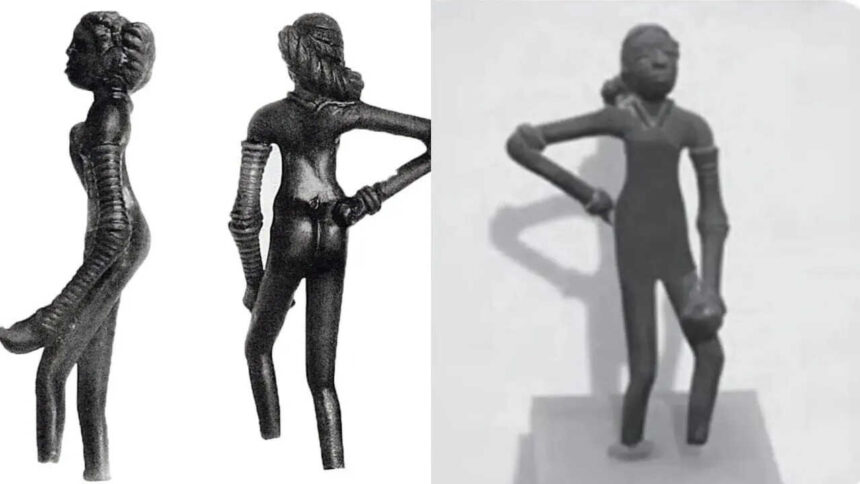
The National Council of Educational Research and Training’s (NCERT) new Class 9 arts textbook has sparked controversy over its depiction of the iconic ‘Dancing Girl’ of Mohenjo-daro, one of the most celebrated artefacts of the Indus Valley Civilisation. The traditionally bare-torsoed bronze statue, dating back to around 2500 BCE, has been visually altered to cover its upper body, raising questions about the representation of historical artefacts in educational materials. This move has ignited a debate about what constitutes ‘age-appropriate’ content in schools and the potential implications of such alterations on the perception of history.
Historical Significance and Cultural Context
The ‘Dancing Girl’ is an exquisite example of the Indus Valley Civilisation’s advanced craftsmanship and artistic expression. The statue, discovered in 1926, is a testament to the sophistication and refinement of the people who created it. By covering the statue’s torso, the NCERT’s textbook has inadvertently diminished the cultural significance and historical importance of the artefact, reducing it to a mere illustration. This alteration has also raised concerns about the potential loss of cultural context and the misrepresentation of historical facts.
The Indus Valley Civilisation is renowned for its unique cultural practices, architectural achievements, and artistic expressions. The ‘Dancing Girl’ is an integral part of this cultural heritage, and its depiction in the NCERT’s textbook should have been approached with sensitivity and respect. Instead, the alteration has sparked a heated debate about the role of educational institutions in shaping the cultural narrative and the potential consequences of such decisions on the younger generation.
Education and Censorship
The NCERT’s decision to alter the ‘Dancing Girl’ has been perceived as a form of censorship, with many arguing that it undermines the principles of academic freedom and intellectual honesty. Educational materials should strive to present historical facts in an unbiased and accurate manner, rather than succumbing to societal pressures or moral agendas. By covering the statue’s torso, the NCERT’s textbook has set a troubling precedent for the potential manipulation of historical artefacts to conform to contemporary norms.
This incident has also raised questions about the role of educational institutions in promoting critical thinking and cultural awareness. Rather than shielding students from the realities of history, educational materials should encourage them to engage with complex issues, fostering a deeper understanding of the cultural context and historical significance of artefacts like the ‘Dancing Girl’. By doing so, students can develop a more nuanced appreciation of the past and its relevance to the present.
Implications and Future Directions
The controversy surrounding the ‘Dancing Girl’ has significant implications for the way historical artefacts are represented in educational materials. It highlights the need for a more thoughtful and inclusive approach to cultural heritage, one that balances the requirements of age-appropriateness with the need for historical accuracy and cultural sensitivity. As educational institutions navigate these complex issues, they must prioritize the development of critical thinking skills, cultural awareness, and intellectual honesty.
The ‘Dancing Girl’ controversy serves as a reminder that the representation of historical artefacts is not just a matter of educational policy, but also a reflection of societal values and cultural norms. As we move forward, it is essential to engage in open and informed discussions about the role of education in shaping our understanding of the past and its relevance to the present. By doing so, we can ensure that future generations approach history with a nuanced appreciation of its complexities and a deeper respect for the cultural heritage that has shaped our world.