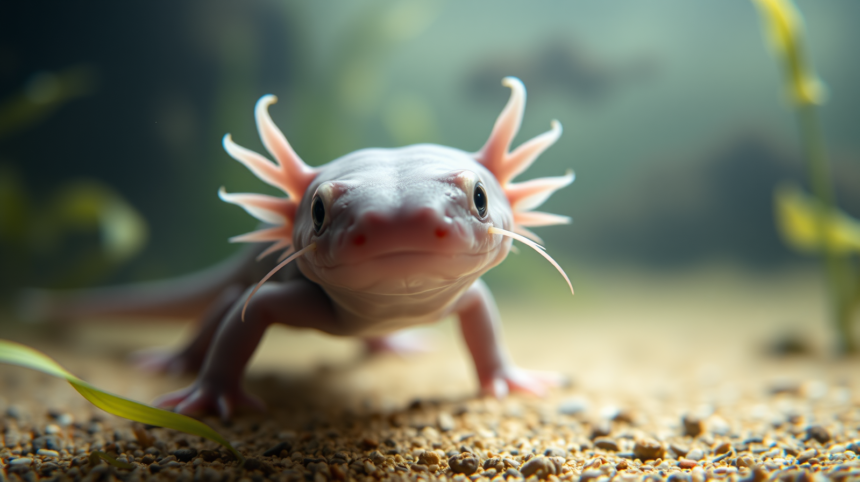
Deep within the depths of a lake in Mexico City lies a creature that defies the fundamental rules of biology. Meet the axolotl, a salamander with the extraordinary ability to regrow its brain, heart, and limbs. Scientists are abuzz with excitement as they attempt to unravel the secrets behind this remarkable phenomenon, hoping to unlock new possibilities for human medicine. This tiny, feathery creature has the potential to rewrite the textbooks on regeneration and open doors to groundbreaking treatments for a range of devastating conditions.
Regeneration: The Key to Unlocking New Treatments
When an axolotl loses a limb, it doesn’t simply heal – it grows back a brand new one, complete with muscle, bone, and nerve tissue. This process is not limited to the physical realm; the axolotl’s brain and heart can also regenerate from even the smallest remnants. The scientific community is fascinated by the axolotl’s ability to orchestrate this complex process, which is thought to involve a combination of stem cells, growth factors, and other cellular players. By studying the axolotl’s regenerative processes, researchers believe they may uncover new approaches to repairing damaged tissue in humans, potentially leading to breakthroughs in the treatment of conditions such as spinal cord injuries, amputations, and even some forms of cancer.
The axolotl’s regenerative abilities are made possible by its unique genetic makeup, which allows it to maintain a state of ‘induced pluripotency,’ essentially keeping its cells in a state of stem-cell-like immaturity. This means that whenever an injury occurs, the axolotl’s cells can quickly differentiate into the necessary types to repair the damaged tissue. Scientists are eager to understand the molecular mechanisms behind this process, hoping to develop treatments that can induce a similar state in human cells.
The Challenges of Translation
While the axolotl’s secrets hold great promise, there are significant challenges to overcome before its regenerative abilities can be translated into human medicine. One major hurdle is the complexity of the human body, which is far more intricate than that of the axolotl. Additionally, the axolotl’s regenerative processes are highly specialized and tailored to its specific biology, making it difficult to adapt these mechanisms to human tissues. Furthermore, any potential treatments would need to be carefully tested for safety and efficacy, a process that will require significant investment and time.
Despite these challenges, researchers remain optimistic that the axolotl’s secrets will eventually be unlocked. By combining cutting-edge technologies, such as gene editing and high-throughput screening, with a deep understanding of the axolotl’s biology, scientists believe they can develop new treatments that will revolutionize human medicine. The axolotl’s regenerative abilities are a beacon of hope, illuminating a path forward for patients suffering from devastating conditions that have long been considered untreatable.
Unraveling the Mysteries of the Axolotl
As researchers continue to unravel the mysteries of the axolotl, they are uncovering a wealth of information about the intricate dance of genes, growth factors, and cellular processes that underlies its remarkable regenerative abilities. By studying the axolotl’s unique biology, scientists are gaining insights into the complex interplay between different cellular pathways, which could lead to a deeper understanding of human development and disease. This knowledge will not only shed light on the axolotl’s remarkable abilities but also have far-reaching implications for human health and disease.
As we peer into the depths of this Mexican lake, we are reminded of the awe-inspiring diversity of life on our planet and the secrets that remain to be uncovered. The axolotl’s regenerative abilities are a testament to the incredible complexity and resilience of nature, and scientists are eager to harness this power to improve human lives. By embracing the unknown and pushing the boundaries of what is thought possible, we may yet uncover the keys to unlocking new treatments and transforming our understanding of human medicine.