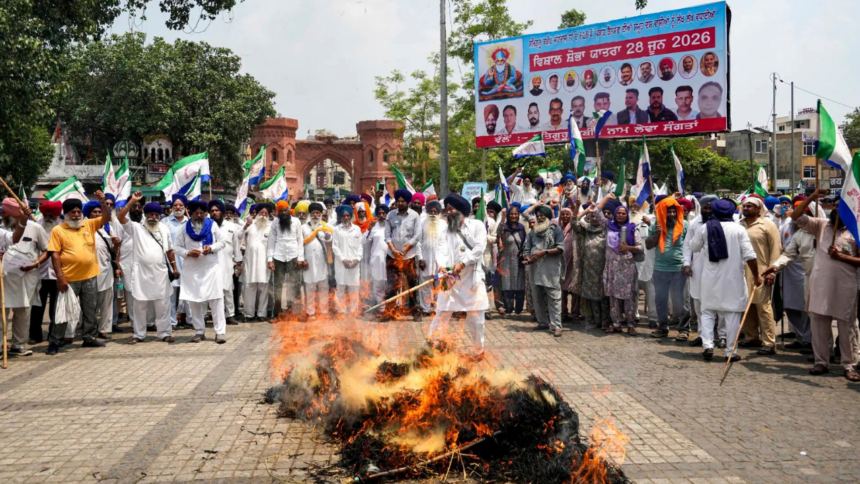
The streets of Punjab witnessed a wave of protests on Wednesday as farmers and labourers under the banner of the Kisan Mazdoor Morcha (KMM) took to the streets to express their discontent with the proposed India-US trade agreement. The protesters alleged that the pact could have far-reaching consequences, harming the interests of farmers, labourers, small traders, and the youth. The demonstrations, which were held at several locations across the state, saw the burning of effigies of Prime Minister Narendra Modi and US President Donald Trump, symbolizing the strong opposition to the trade deal.
Understanding the Trade Agreement
The proposed India-US trade agreement has been a topic of discussion for several months, with both countries engaging in negotiations to strengthen their trade ties. However, the agreement has not been well-received by farmers and labourers, who fear that it could lead to the influx of cheap imports, thereby affecting their livelihoods. The protesters claim that the agreement is ‘anti-farmer’ and ‘anti-worker’, and that it could have a devastating impact on the country’s agricultural sector.
The KMM has been vocal about its opposition to the trade agreement, stating that it could lead to the exploitation of farmers and labourers by multinational corporations. The organization has demanded that the government reconsider the agreement and engage in consultations with stakeholders to ensure that the interests of farmers and labourers are protected. The protests in Punjab are a testament to the growing unrest among farmers and labourers, who feel that their concerns are being ignored by the government.
The Impact on Farmers and Labourers
The proposed trade agreement has the potential to affect farmers and labourers in several ways. One of the primary concerns is that the agreement could lead to the import of cheap agricultural products, such as wheat and rice, from the US. This could result in a decline in the demand for domestically produced crops, thereby affecting the livelihoods of farmers. Additionally, the agreement could also lead to the influx of cheap labour from other countries, which could further exacerbate the problems faced by labourers in India.
The protesters have also expressed concerns about the impact of the agreement on the country’s food security. They claim that the agreement could lead to the dependence on imported food products, which could compromise the country’s food security. The KMM has demanded that the government prioritize the interests of farmers and labourers, and ensure that the agreement does not harm their livelihoods. The protests in Punjab are a call to action, urging the government to reconsider the agreement and engage in consultations with stakeholders to ensure that the interests of all parties are protected.
A Call to Action
The protests in Punjab are a testament to the growing unrest among farmers and labourers, who feel that their concerns are being ignored by the government. The KMM has called upon the government to reconsider the trade agreement and engage in consultations with stakeholders to ensure that the interests of farmers and labourers are protected. The organization has also demanded that the government prioritize the interests of farmers and labourers, and ensure that the agreement does not harm their livelihoods.
The protests have sparked a national debate about the impact of the proposed trade agreement on farmers and labourers. The government has been urged to reconsider the agreement and engage in consultations with stakeholders to ensure that the interests of all parties are protected. As the protests continue to gain momentum, it remains to be seen how the government will respond to the concerns of farmers and labourers. One thing is certain, however – the proposed trade agreement has sparked a wave of fury among farmers and labourers, who will not hesitate to make their voices heard.