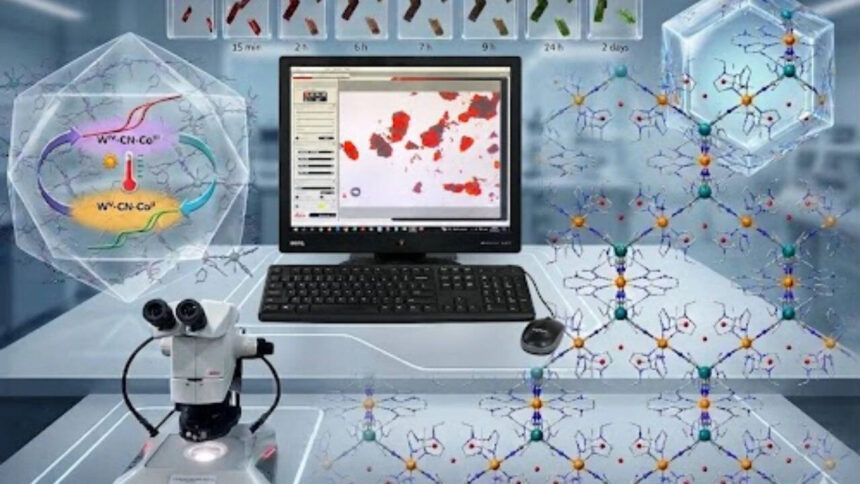
A team of scientists at the Indian Institute of Science (IISc) has made a groundbreaking discovery that could transform the way we develop industrial sensors, data storage devices, and quantum technologies. By creating a new class of ‘smart’ materials that can change their magnetic properties in response to external stimuli such as light, heat, or pressure, the researchers have paved the way for the development of more sensitive, efficient, and powerful devices. This innovative breakthrough has the potential to revolutionize various fields, from healthcare and environmental monitoring to telecommunications and computing.
Understanding Smart Materials
The newly developed smart materials are a type of molecular system that can alter their magnetic properties in response to changes in their environment. This unique ability allows them to adapt to different situations, making them ideal for a wide range of applications. For instance, these materials could be used to create ultra-sensitive sensors that can detect even slight changes in temperature, pressure, or light, enabling more accurate monitoring and control of industrial processes. Additionally, their ability to change their magnetic properties in response to external stimuli could be leveraged to develop more efficient data storage devices, such as magnetic hard drives, which could store vast amounts of data while consuming less power.
The IISc team’s discovery is significant because it provides a new platform for the development of smart materials with tailored properties. By carefully designing the molecular structure of these materials, researchers can create systems that respond to specific stimuli, allowing for the creation of customized sensors and devices. This level of control and flexibility is unprecedented and could lead to the development of novel technologies that were previously unimaginable. Furthermore, the fact that these materials can be designed to respond to multiple stimuli makes them even more versatile, enabling the creation of devices that can detect and respond to a wide range of environmental changes.
Applications and Implications
The potential applications of the IISc team’s discovery are vast and varied. In the field of healthcare, for example, smart materials could be used to develop sensors that can detect biomarkers for diseases, allowing for earlier diagnosis and treatment. In environmental monitoring, these materials could be used to create sensors that can detect pollutants and toxins, enabling more effective monitoring and regulation of environmental quality. The development of more efficient data storage devices could also have a significant impact on the field of computing, enabling the creation of faster, more powerful computers that consume less energy.
The implications of this breakthrough are also significant, as it could lead to the development of new industries and job opportunities. The creation of smart materials with tailored properties could enable the development of novel products and technologies, from self-healing materials to shape-shifting devices. Additionally, the fact that these materials can be designed to respond to multiple stimuli makes them ideal for use in complex systems, such as autonomous vehicles and smart homes, where they could be used to detect and respond to a wide range of environmental changes.
Future Directions
While the IISc team’s discovery is a significant breakthrough, there is still much work to be done to fully realize the potential of these smart materials. Further research is needed to develop a deeper understanding of the underlying mechanisms that govern their behavior and to explore their potential applications in various fields. Additionally, the development of scalable and cost-effective methods for synthesizing these materials will be crucial for their widespread adoption. Nevertheless, the potential rewards are well worth the effort, as the development of smart materials with tailored properties could lead to significant advances in a wide range of fields and improve our daily lives in countless ways.
The IISc team’s discovery is a testament to the power of scientific research and its potential to transform our world. As we continue to push the boundaries of human knowledge and innovation, we can expect to see even more exciting breakthroughs and discoveries that will shape the future of our planet. With the development of smart materials, we are one step closer to creating a world that is more efficient, sustainable, and responsive to our needs, and it will be exciting to see where this technology takes us in the years to come.