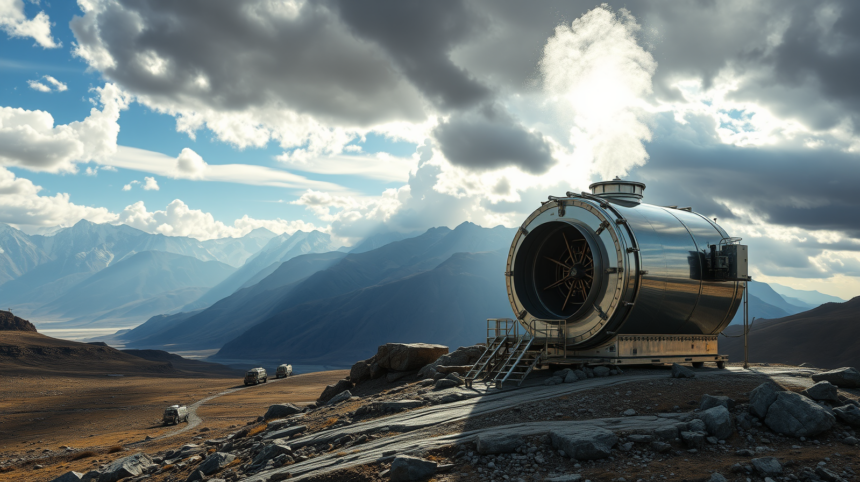
The idea of harnessing the power of the sky to bring life-giving water to China’s parched north may seem like the stuff of science fiction, but for the engineers behind the Tianhe project, it’s a very real – and ambitious – plan to tame the weather. In 2018, Chinese state media announced a proposal to build a massive airborne water corridor across the Tibetan Plateau, one that would use tens of thousands of cloud seeding chambers to divert monsoon moisture from the Indian Ocean towards China’s drier regions. The goal: to bring a little piece of tropical paradise to the heart of Asia.
What is Tianhe and how does it work?
Tianhe, which translates to ‘sky river,’ is a complex system of cloud seeding chambers, weather stations, and data analysis centers designed to manipulate the atmospheric conditions over the Tibetan Plateau. The project’s proponents believe that by seeding clouds with silver iodide, they can stimulate the formation of precipitation patterns that will bring much-needed moisture to China’s northern provinces. The plan is to deploy the cloud seeding chambers across an area roughly the size of Alaska, creating a vast network of ‘atmospheric pipes’ that will direct the monsoon winds towards the parched regions.
But how would this work in practice? Imagine a system of miniature weather factories, each churning out clouds of silver iodide that will interact with the atmospheric conditions to produce precipitation. The data from the weather stations and sensors will be fed into complex computer models, which will then predict the exact locations and intensities of the precipitation patterns. It’s a highly ambitious and untested plan, but one that holds out the promise of bringing much-needed water to some of China’s driest regions.
The Science Behind Tianhe
So what’s the science behind Tianhe? Cloud seeding has been around for decades, but its effectiveness has always been a topic of debate. Some studies have suggested that cloud seeding can increase precipitation by up to 20%, while others have found little to no effect. However, the scientists behind Tianhe are convinced that their approach will be different. By using a combination of weather forecasting models and real-time data analysis, they believe they can pinpoint the exact locations and conditions where cloud seeding will be most effective.
The project’s proponents also point out that the Tibetan Plateau is a unique environment, with a high altitude and distinct atmospheric conditions that make it an ideal location for cloud seeding. The plateau’s rugged terrain and prevailing wind patterns create a natural ‘atmospheric lens’ that can be used to focus the monsoon winds and bring precipitation to the parched regions below.
The Challenges Ahead
Of course, Tianhe is not without its challenges. For one thing, the project’s sheer scale is daunting – deploying tens of thousands of cloud seeding chambers across an area the size of Alaska is a logistical nightmare. There are also concerns about the environmental impact of the project, including the potential for disrupting local ecosystems and altering the natural precipitation patterns of the region.
And then there’s the question of cost. Estimates suggest that the project could cost billions of dollars to implement, which could be a major hurdle for the Chinese government. But despite these challenges, the scientists behind Tianhe remain optimistic. They believe that their project could be a game-changer for China’s dry regions, bringing life-giving water to millions of people and transforming the country’s economy.
As the world watches with bated breath, the fate of Tianhe hangs in the balance. Will it prove to be a groundbreaking innovation that brings water to the parched regions of China, or will it prove to be a costly and ill-fated experiment? Only time will tell, but one thing is certain – the stakes are high, and the world is holding its breath for the outcome.