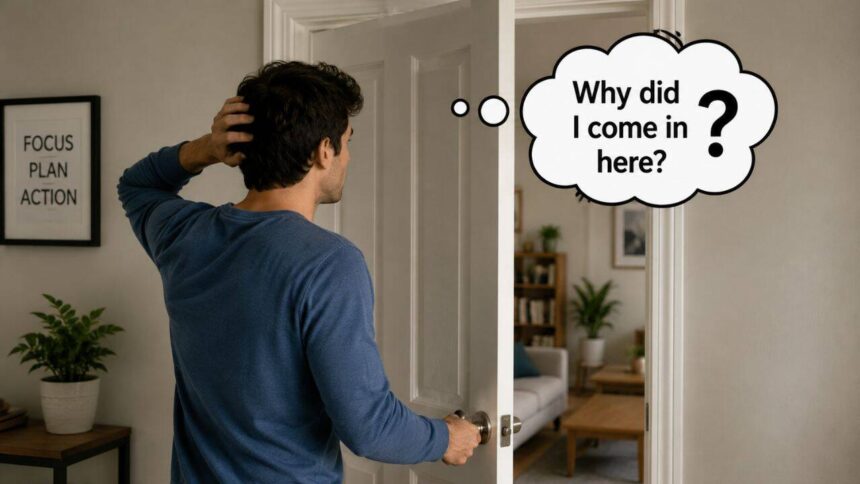
Imagine this scenario: you’re on a mission to retrieve something from the kitchen, perhaps a glass of water or a snack to hold you over until dinner. You stride purposefully toward the kitchen, your mind focused on the task at hand. Yet, as you reach the threshold, your thoughts suddenly go blank. You’re standing in front of the kitchen door, staring blankly into space, wondering why you came here in the first place. This phenomenon is so common that it’s become a familiar joke among family and friends: ‘I walked into this room, but now I have no idea why.’ But what’s behind this mysterious loss of memory, and why does it happen to us so often?
Theories and Explanations
One theory is that our brains are wired to focus on the present moment, rather than dwelling on past events or future possibilities. When we enter a new environment, such as a kitchen or living room, our brain’s attention shifts to the sensory input from our surroundings. This can lead to a temporary disruption in our working memory, making it difficult to recall the original reason for entering the space. Additionally, our brains have a limited capacity for holding information, and the transition from one task to another can lead to a mental ‘reset,’ making it challenging to recall prior intentions.
This phenomenon is often referred to as the ‘doorway effect,’ and it’s not limited to kitchens or living rooms. It can happen in any situation where we transition from one environment to another. For example, walking from one room to another, entering a new building, or even switching between tasks on a computer. The doorway effect highlights the complexities of human memory and the ways in which our environment influences our cognitive processes.
The Science of Memory
Research in the field of cognitive psychology has shown that our brains use a network of interconnected nodes to store and retrieve information. When we learn new information, it’s stored in short-term memory, where it can be retrieved and manipulated. However, the information is only held in this temporary storage for a short period, typically between a few seconds and a few minutes. If we don’t actively engage with the information, it’s lost forever. The doorway effect can be seen as a manifestation of this temporary storage mechanism, where the original intention or reason for entering a space is forgotten due to a lack of active engagement.
Furthermore, studies have shown that the transition between tasks or environments can lead to a phenomenon called ‘context switching.’ This occurs when our brain struggles to adapt to a new environment or task, resulting in a decrease in productivity and accuracy. The doorway effect can be seen as a manifestation of this context switching, where our brain is attempting to adjust to a new environment, but in the process, loses track of the original intention.
Implications and Applications
The doorway effect has significant implications for our daily lives and can inform various fields, including education, psychology, and design. For instance, in the classroom, teachers can use strategies to minimize the doorway effect, such as providing explicit instructions and reminders, or using visual aids to help students remember their tasks. In the field of psychology, researchers can use the doorway effect to better understand the complexities of human memory and develop more effective interventions for individuals with memory impairments. In design, architects and interior designers can use the doorway effect to create spaces that promote cognitive flow and minimize distractions.
By uncovering the science behind the doorway effect, we can gain a deeper understanding of the intricate workings of the human brain and develop strategies to mitigate the consequences of this phenomenon. Whether it’s in our daily lives, educational settings, or design environments, the doorway effect serves as a reminder of the complexities of human memory and the importance of staying focused and engaged in our surroundings.
So the next time you find yourself standing in front of a door, wondering why you walked into a room, remember that it’s not just a case of forgetfulness. It’s a fascinating glimpse into the workings of the human brain, and a reminder of the intricate dance between our environment and our cognitive processes.