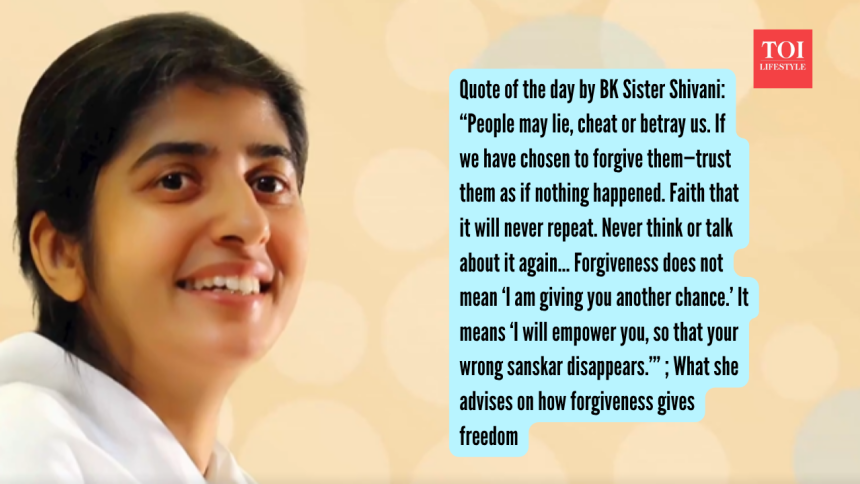
Every relationship, whether with family, friends, colleagues, or partners, is built on the invisible foundation of trust. Yet, no relationship is completely free from misunderstandings, mistakes, or moments that leave us hurt. In such situations, forgiveness can be a difficult but liberating choice. As BK Sister Shivani so eloquently puts it, “People may lie, cheat or betray us. If we have chosen to forgive them—trust them as if nothing happened…It means ‘I will empower you, so that your wrong sanskar disappears.’” Her words highlight the profound impact of forgiveness on both the giver and the receiver, and how it can lead to a deeper understanding and freedom from the burdens of resentment and anger.
Understanding the Power of Forgiveness
Forgiveness is often misconstrued as a sign of weakness or vulnerability. However, it is actually a sign of strength and courage. When we choose to forgive, we are not condoning or justifying the hurtful behavior of others, but rather, we are releasing ourselves from the toxic emotions that come with holding onto resentment. Forgiveness allows us to break free from the cycle of negativity and move forward with a sense of peace and clarity. As Sister Shivani advises, trusting someone who has wronged us, as if nothing happened, is not about ignoring the past, but about empowering the other person to change and grow.
This approach to forgiveness is rooted in the understanding that people’s actions are often a reflection of their own pain and suffering. When we forgive, we are not only freeing ourselves, but also giving the other person the opportunity to heal and transform. By letting go of our anger and resentment, we create space for compassion, empathy, and understanding to flourish. This, in turn, can lead to deeper and more meaningful relationships, built on mutual respect and trust.
The Freedom of Forgiveness
The act of forgiveness can be incredibly liberating, as it allows us to release the emotional burden of past hurts and move forward with a sense of freedom and lightness. When we hold onto resentment and anger, we are essentially giving the person who hurt us control over our emotions and well-being. Forgiveness, on the other hand, gives us back our power and autonomy, allowing us to live in the present moment, unencumbered by the weight of past grievances. As Sister Shivani so beautifully puts it, forgiveness is about empowering the other person to change, but it is also about empowering ourselves to live a life of freedom, joy, and purpose.
Furthermore, forgiveness is not a one-time event, but a process that requires patience, self-reflection, and commitment. It involves acknowledging our emotions, working through our pain, and making a conscious choice to let go of our resentment. This process can be challenging, but it is also incredibly rewarding, as it allows us to develop greater self-awareness, self-compassion, and emotional intelligence. By choosing to forgive, we are not only healing ourselves, but also contributing to the creation of a more compassionate and harmonious world.
Cultivating a Culture of Forgiveness
As we navigate the complexities of our personal and professional relationships, it is essential that we cultivate a culture of forgiveness. This involves creating a safe and supportive environment, where people feel encouraged to apologize, make amends, and work towards healing and growth. It also involves recognizing that forgiveness is not always easy, and that it may take time, effort, and patience to work through our emotions and come to a place of understanding and compassion.
By embracing forgiveness as a core value, we can create a more empathetic and resilient community, where people feel empowered to take risks, make mistakes, and learn from their experiences. As Sister Shivani’s words remind us, forgiveness is not just about the other person; it is about ourselves, our well-being, and our freedom. By choosing to forgive, we are not only healing others, but also ourselves, and contributing to the creation of a more just, compassionate, and peaceful world.
In the end, forgiveness is a choice that can bring us immense peace, freedom, and joy. It is a choice that requires courage, compassion, and wisdom, but one that can lead to profound transformation and growth. As we reflect on Sister Shivani’s words, may we be inspired to embark on our own journey of forgiveness, and may we discover the liberating power of letting go.