Imagine being able to see the universe with perfect clarity, without the distortions that have hindered astronomers for centuries. This is now a reality, thanks to a groundbreaking technology that creates artificial stars in the sky. By overcoming the limitations of atmospheric distortion, scientists can study the universe in unprecedented detail, and the implications are vast.
Overcoming the Limitations of the Atmosphere
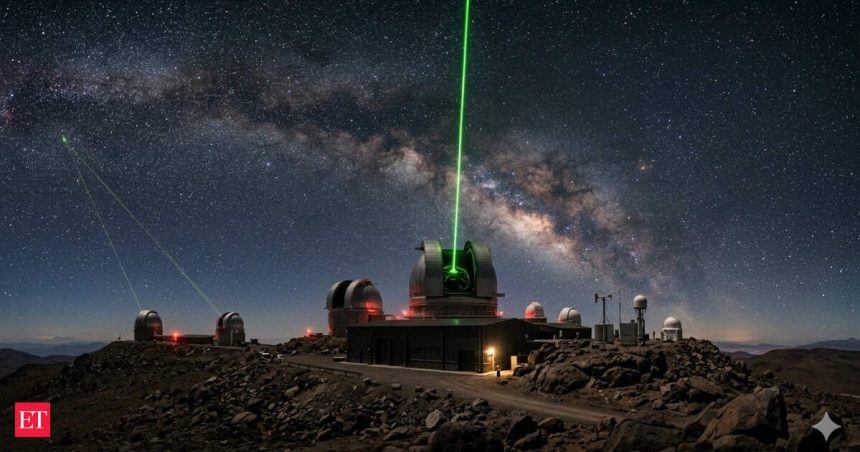
The Earth’s atmosphere has long been a major obstacle for astronomers, as it distorts and blurs the light from distant stars and planets. This distortion makes it difficult to get a clear view of the universe, and has limited the accuracy of many astronomical observations. However, with the development of laser guide star technology, scientists can now create artificial stars that allow them to correct for these distortions. By shining a powerful laser into the sky, astronomers can create a bright, artificial star that can be used as a reference point to analyze and correct the light from other celestial objects.
This technology has been a major breakthrough for the field of astronomy, as it enables scientists to study the universe with unprecedented precision. With the ability to correct for atmospheric distortion, astronomers can now observe distant planets and stars in exquisite detail, and gain a deeper understanding of the workings of the universe. This has already led to some remarkable discoveries, including the detection of exoplanets that are similar in size and composition to Earth.
Exploring the Universe with Unprecedented Precision
The ability to create artificial stars has also enabled scientists to study the universe in new and innovative ways. By using these artificial stars as reference points, astronomers can now make precise measurements of the movement and properties of celestial objects. This has allowed them to gain a deeper understanding of the formation and evolution of the universe, and has shed new light on some of the most fundamental questions in astronomy. For example, scientists can now study the formation of galaxies in unprecedented detail, and gain insights into the role of dark matter and dark energy in the universe.
The use of artificial stars has also enabled astronomers to develop new and innovative observing techniques. By using these stars as reference points, scientists can now make precise measurements of the properties of distant planets, including their size, composition, and atmospheric properties. This has allowed them to search for planets that are capable of supporting life, and has raised hopes of eventually finding evidence of extraterrestrial life.
A New Era for Astronomy
The development of laser guide star technology has marked the beginning of a new era for astronomy. With the ability to create artificial stars, scientists can now study the universe with unprecedented precision and accuracy. This has opened up new avenues of research, and has raised hopes of making some remarkable discoveries in the years to come. As astronomers continue to develop and refine this technology, we can expect to see some major breakthroughs in our understanding of the universe.
One of the most exciting aspects of this technology is its potential to democratize access to space exploration. By enabling scientists to make precise observations from the ground, laser guide star technology has the potential to reduce the cost and complexity of space exploration. This could make it possible for smaller countries and organizations to participate in astronomical research, and could lead to a new era of international cooperation and collaboration in the field of astronomy.
As we look to the future, it is clear that the development of laser guide star technology will have a profound impact on the field of astronomy. With its ability to create artificial stars and correct for atmospheric distortion, this technology has the potential to revolutionize our understanding of the universe. As scientists continue to develop and refine this technology, we can expect to see some major breakthroughs in the years to come, and can look forward to a future of unprecedented discovery and exploration.