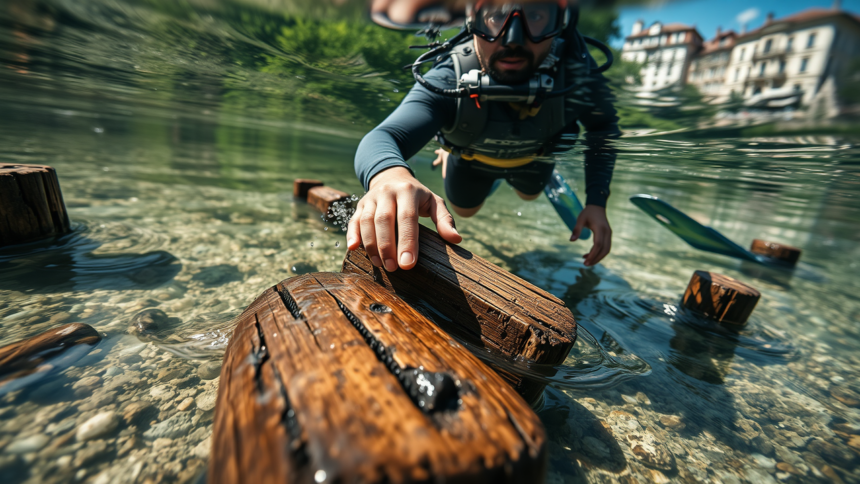
A team of divers has made a groundbreaking discovery in the Aare River at Solothurn, Switzerland, unearthing the remains of a 1,700-year-old Roman bridge that historians had been searching for decades. The finding is a significant archaeological breakthrough, shedding new light on the region’s rich history and providing a unique glimpse into the engineering prowess of the ancient Romans. For years, historians had been convinced that a Roman bridge once crossed the Aare River, but until now, they had no concrete evidence to support their claims.
Historical Significance
The Roman bridge, dated to the fourth century CE, is an extraordinary find, offering a fascinating insight into the region’s past. Historians believe that the bridge was an important crossing point for trade and commerce, connecting the Roman provinces of Gaul and Germania. The discovery of the bridge’s remains is a testament to the advanced engineering skills of the ancient Romans, who were able to design and build complex structures that withstood the test of time.
The discovery was made possible by a team of divers who were hired to conduct a survey of the riverbed ahead of renovation work on a nearby railway bridge. Using specialized equipment, the divers were able to locate and excavate the wooden piles that once supported the Roman bridge. The piles, which were remarkably well-preserved, were dated using radiocarbon analysis, confirming that they were indeed from the fourth century CE.
Archaeological Implications
The discovery of the Roman bridge has significant implications for archaeologists and historians, who will be able to study the remains to gain a better understanding of the region’s history. The bridge’s design and construction will provide valuable insights into the engineering techniques used by the ancient Romans, while the artifacts found at the site will offer a glimpse into the daily lives of the people who used the bridge. The finding will also help to shed light on the region’s economic and cultural development during the Roman period.
The excavation of the Roman bridge is a complex and challenging process, requiring careful planning and execution. Archaeologists will need to work closely with engineers and conservationists to ensure that the site is properly excavated and preserved for future generations. The discovery is a significant one, and it is likely to attract international attention, with scholars and enthusiasts from around the world eager to learn more about this remarkable find.
Preservation and Conservation
The discovery of the Roman bridge has sparked a lively debate about how to preserve and conserve the site for future generations. Archaeologists and historians are keen to ensure that the remains are protected and preserved, while engineers and conservationists are working to develop a plan to safeguard the site from damage or destruction. The Swiss government has announced plans to establish a protected area around the site, which will help to prevent unauthorized access and ensure that the remains are preserved for years to come.
The discovery of the 1,700-year-old Roman bridge in the Aare River is a remarkable find, one that will continue to captivate scholars and enthusiasts for years to come. As archaeologists and historians continue to study the site, they will undoubtedly uncover more secrets about the region’s rich history, providing a unique glimpse into the lives of the people who lived and worked in the area centuries ago. The finding is a powerful reminder of the importance of preserving our cultural heritage, and the need to protect and conserve our historical sites for future generations.