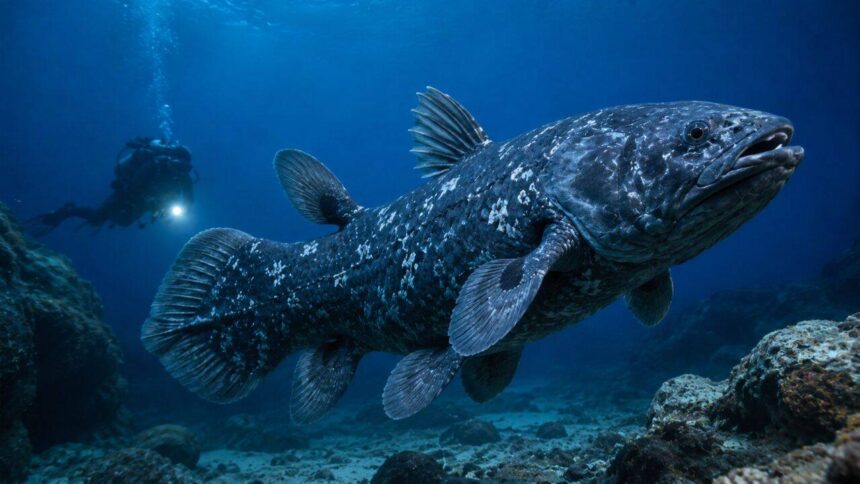
It’s one of the most astonishing stories in modern science – a fish thought to have been extinct for 66 million years, a relic from the age of dinosaurs, has reappeared. For decades, the coelacanth existed in scientific literature as a creature of the distant past, a reminder of a bygone era. Fossils of this ancient fish lineage had lived alongside the mighty T-Rex and other prehistoric creatures, only to vanish from the fossil record around the time of the mass extinction event that wiped out the dinosaurs. But in 1938, a live coelacanth was caught off the coast of South Africa, sending shockwaves through the scientific community.
Rediscovery and the Quest for Answers
When the live coelacanth was first found, scientists were initially skeptical. They thought it was a hoax or a misidentification of a known species. But as more specimens were caught and examined, it became clear that this was indeed a unique and ancient creature. The coelacanth’s distinctive lobed fins and scaly skin were unlike anything else in the ocean, and its DNA revealed a surprising connection to the earliest vertebrates on Earth. Researchers were eager to learn more about this relic from the past, but the coelacanth proved to be a challenging subject. It was a deep-sea dweller, living at depths of over 200 meters, and it refused to be caught or studied in the wild.
For decades, scientists relied on the occasional capture of a live coelacanth to study its behavior and biology. They were amazed by its slow metabolism, its ability to survive on a diet of small fish and squid, and its unique way of swimming using its powerful tail. But despite these advances, the coelacanth remained an enigma, a creature shrouded in mystery. What drove it to the depths of the ocean? How did it adapt to the changing environment? And what secrets lay hidden in its ancient DNA?
Unlocking the Secrets of the Coelacanth
In recent years, advances in genetic analysis and underwater exploration have allowed scientists to unlock the secrets of the coelacanth. By studying the DNA of museum specimens and comparing it to modern fish, researchers have gained a deeper understanding of the coelacanth’s evolution and its place in the tree of life. They have also used underwater cameras and submersibles to observe the coelacanth in its natural habitat, revealing its social behavior and mating rituals. But perhaps the most surprising discovery has been the coelacanth’s ability to thrive in a modern ocean filled with predators and competitors.
Despite being a relic from the age of dinosaurs, the coelacanth has proven to be an adaptable and resilient creature. It has been able to survive in a world where its ancestors once ruled supreme, and it continues to fascinate scientists and the public alike. As we continue to explore the depths of the ocean and uncover the secrets of the coelacanth, we are reminded of the incredible diversity and complexity of life on Earth.
The Coelacanth Legacy
The rediscovery of the coelacanth has also sparked a renewed interest in the study of ancient species and their potential to inform our understanding of modern ecosystems. It has shown us that even the most unlikely creatures can hold the key to unlocking new insights into the history of life on Earth. And as we look to the future, we are reminded of the importance of preserving our oceans and the incredible biodiversity that they support.
The coelacanth may be a relic from the past, but its legacy will continue to inspire and educate us for generations to come. It is a reminder that even in the depths of time, there is always more to discover, and that the natural world is full of secrets waiting to be uncovered.