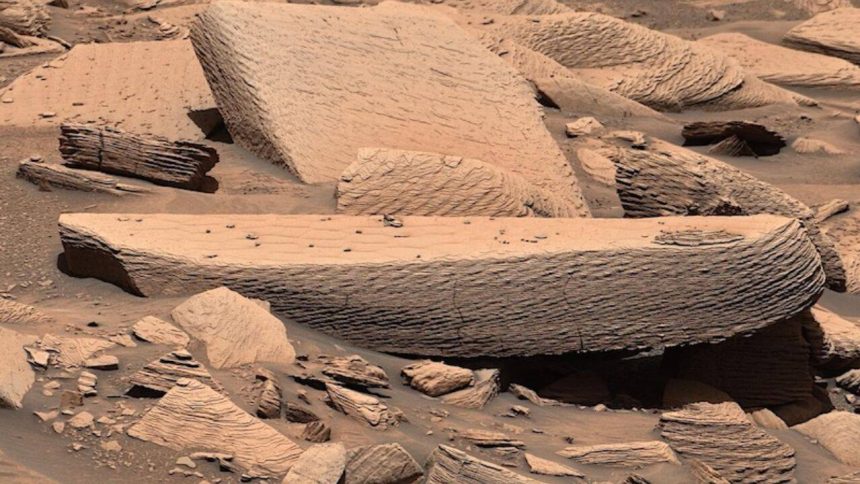
NASA’s Curiosity rover has made a groundbreaking discovery on Mars, unearthing evidence of an ancient sandstorm that has been preserved in rocks for billions of years. The remarkable find was made in a patch of rock inside Gale Crater, where the rover has been exploring since 2012. What initially appeared to be a collection of layered stone has turned out to be a record of a single weather event that unfolded billions of years ago, offering scientists a fascinating glimpse into the Red Planet’s turbulent past.
Uncovering the Ancient Storm
The discovery was made possible by the rover’s advanced instrumentation, which allowed scientists to study the rocks in unprecedented detail. The layered stone, known as a cross-bedded sequence, is composed of sand-sized grains that have been cemented together over time. By analyzing the orientation and distribution of these grains, researchers were able to reconstruct the conditions under which they were deposited. The results suggest that the rocks were formed as a result of a massive sandstorm that swept across the Martian surface, carrying sand and dust with it.
The fact that these rocks have been preserved for so long is a testament to the harsh and unforgiving environment on Mars. The planet’s thin atmosphere and lack of liquid water mean that the rocks have been shielded from the erosive forces that would have worn them away on Earth. As a result, the cross-bedded sequence has remained intact, providing a unique window into the Martian past. Scientists are eager to learn more about the ancient storm and its impact on the planet’s geology, and the discovery has sparked a new wave of research into the Red Planet’s fascinating history.
Mars’ Turbulent Past
Mars is known for its powerful dust storms, which can last for days or even weeks. These storms are driven by the planet’s thin atmosphere and the abrasive nature of the Martian soil. The storms can be so intense that they even affect the planet’s climate, with some storms triggering massive dust devils that can be thousands of feet tall. The discovery of the ancient sandstorm suggests that these events have been a feature of the Martian landscape for billions of years, shaping the planet’s geology and influencing its climate.
The study of Martian geology has revealed a complex and fascinating history, with evidence of ancient rivers, lakes, and even oceans. The discovery of the cross-bedded sequence adds a new chapter to this story, highlighting the role of powerful storms in shaping the planet’s surface. By studying these rocks and the events that formed them, scientists hope to gain a deeper understanding of the Martian environment and its potential for supporting life. The discovery has also sparked interest in the possibility of similar storms occurring on other planets, and the potential for these events to shape the geology of other worlds.
Implications for Future Research
The discovery of the ancient sandstorm has significant implications for future research on Mars. The finding suggests that the planet’s surface may hold many more secrets and surprises, waiting to be uncovered by intrepid explorers. The study of Martian geology has already revealed a wealth of information about the planet’s history and evolution, and the discovery of the cross-bedded sequence is a powerful reminder of the importance of continued exploration and research. As scientists continue to study the Red Planet, they may uncover even more evidence of the planet’s turbulent past, shedding new light on the mysteries of the Martian environment.
The discovery of the ancient sandstorm is a powerful reminder of the awe-inspiring beauty and complexity of the Martian landscape. As we continue to explore and study the Red Planet, we are constantly reminded of the many wonders that await us in the universe. The discovery of the cross-bedded sequence is a testament to the power of human curiosity and the importance of continued exploration and research, and it is likely to inspire a new generation of scientists and explorers to venture forth into the unknown.