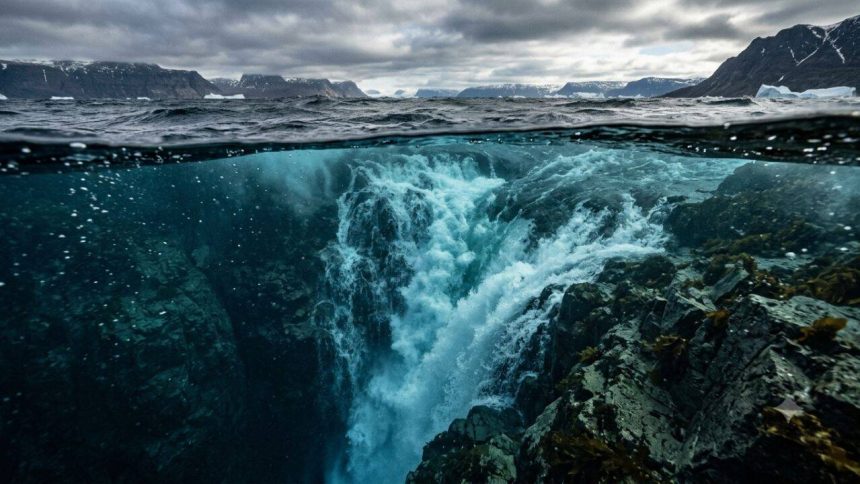
The world’s largest waterfall is not a spectacle that can be seen from the surface, or indeed from the nearest tourist information centre. For most people, the idea of the world’s largest waterfall conjures up images of towering cliffs, crashing water, and famous landmarks such as Niagara or Angel Falls. Yet, Earth’s biggest waterfall is nowhere to be seen – it’s hidden beneath the ocean, where billions of litres of water plunge every second.
This astonishing phenomenon occurs at the Denmark Strait Cataract, located between Iceland and Greenland in the North Atlantic Ocean. Here, a submarine plateau drops steeply into the depths of the ocean, creating a natural ‘waterfall’ in the process. The resulting torrent is estimated to be around 4-6 times the volume of the famous Victoria Falls in Africa, but its existence has long gone unrecognised by the general public.
The Denmark Strait Cataract is not simply a curiosity, but an important component of the Earth’s ocean circulation. The immense volume of water that flows over the plateau plays a crucial role in regulating the global climate. Scientists have long been fascinated by the potential impact of the Denmark Strait Cataract on the Earth’s oceans, but its remote location and lack of visibility have made it a challenging subject to study.
The Discovery and Significance of the Denmark Strait Cataract
The Denmark Strait Cataract was first identified by scientists in the 1990s, who used satellite imagery and oceanographic data to map the submarine plateau. Since then, a number of research expeditions have been conducted to study the phenomenon in greater detail. One of the key findings of these expeditions has been the role of the Denmark Strait Cataract in the formation of North Atlantic Deep Water, a critical component of the global ocean circulation.
The Denmark Strait Cataract is an example of a ‘submarine waterfall’ – a phenomenon where a river or stream of water flows over a submerged obstacle, such as a submarine plateau or a trench. While other submarine waterfalls have been identified around the world, the Denmark Strait Cataract remains the largest and most impressive. Its existence has significant implications for our understanding of the Earth’s oceans and their role in regulating the global climate.
The Challenges of Studying the Denmark Strait Cataract
Despite its importance, the Denmark Strait Cataract remains a challenging subject to study. The remote location of the submarine plateau, combined with the harsh conditions of the North Atlantic Ocean, make it difficult for scientists to collect data and conduct research. Additionally, the sheer scale of the Denmark Strait Cataract makes it a daunting task to visualise and model the phenomenon.
However, the challenges of studying the Denmark Strait Cataract have not deterred scientists from pursuing a deeper understanding of this phenomenon. Researchers continue to use cutting-edge technology, such as satellite imaging and autonomous underwater vehicles, to study the Denmark Strait Cataract in greater detail. Their findings have significant implications for our understanding of the Earth’s oceans and their role in regulating the global climate.
The Future of Denmark Strait Cataract Research
As our understanding of the Denmark Strait Cataract continues to grow, so too do the implications for our understanding of the Earth’s oceans. The discovery of the Denmark Strait Cataract highlights the importance of continued research into the world’s oceans and their role in regulating the global climate. By studying this phenomenon, scientists can gain a deeper understanding of the complex interactions between the Earth’s oceans, atmosphere, and land surfaces.
The Denmark Strait Cataract is a reminder that there is still much to be discovered about our planet, even in the most unexpected places. As scientists continue to study this phenomenon, we can expect to learn more about the importance of the Denmark Strait Cataract in regulating the global climate, and the critical role it plays in shaping our planet’s oceans.
The discovery of the Denmark Strait Cataract is a testament to the power of scientific research and exploration, and a reminder that there is still much to be learned about our planet and its many wonders.