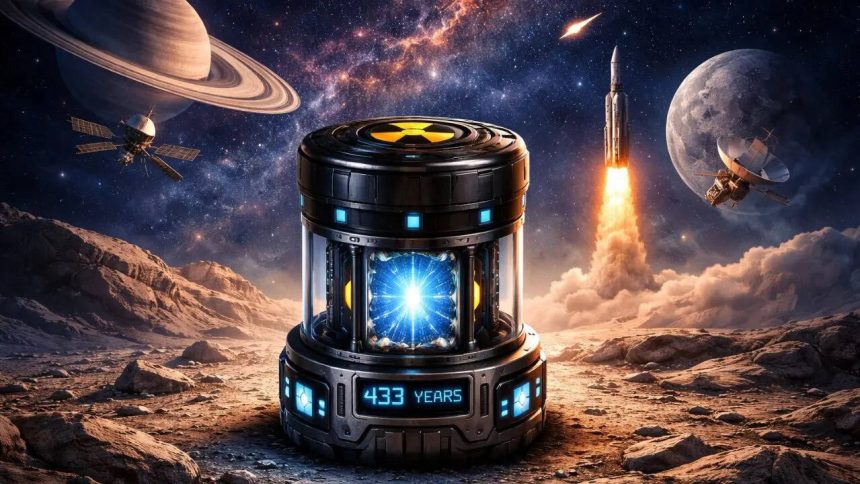
The vastness of space is often associated with limitless possibility, but it’s also a realm where the constraints of technology can be particularly stark. Solar panels, for instance, are notoriously inefficient in deep space, where the absence of sunlight renders them nearly useless. However, scientists have been working tirelessly to develop power systems that can function in these extreme conditions, and recent breakthroughs suggest a promising solution may be within reach: nuclear batteries.
Nuclear batteries, also known as radioisotope thermoelectric generators (RTGs), harness the heat energy produced by radioactive decay to generate electricity. This principle has been successfully applied in a range of space missions, including NASA’s Cassini and Voyager probes. However, the latest generation of nuclear batteries promises to be significantly more efficient, with the potential to power missions for centuries.
At the heart of this innovation lies a cutting-edge design, which incorporates advanced materials and a novel architecture to increase energy output while minimizing size and weight. These improvements have been made possible by advances in nuclear technology and materials science, enabling the development of more powerful and compact radioisotope thermoelectric converters.
Powering the Next Frontier
So what does this mean for the future of space exploration? The implications are profound. With nuclear batteries capable of lasting 433 years or more, the possibilities for long-duration missions become almost limitless. The technology could enable humanity to establish a permanent presence on the Moon or Mars, or even send probes to distant star systems.
One of the most significant advantages of nuclear batteries is their ability to operate independently of sunlight, making them ideal for deep space missions where solar panels are ineffective. This is particularly important for missions to the outer planets and beyond, where the distance from the Sun makes solar power nearly impossible.
The development of nuclear batteries also raises questions about the long-term sustainability of space exploration. If we can create power systems that can function for centuries, what does this mean for our understanding of the universe and our place within it?
Nuclear Energy: The Key to Unlocking the Secrets of Space
Nuclear batteries are not only a game-changer for power generation in space but also have significant implications for our understanding of the universe. By enabling long-duration missions, scientists can gather data that was previously inaccessible, shedding new light on some of the most fundamental questions in astrophysics.
For example, nuclear-powered missions could be used to study the mysterious dark matter and dark energy that make up a significant portion of the universe’s mass-energy budget. By exploring the farthest reaches of the cosmos, scientists can gain a deeper understanding of the universe’s evolution and the laws of physics that govern it.
The potential of nuclear batteries to revolutionize space exploration is undeniable. As scientists continue to push the boundaries of this technology, we can expect even more innovative applications in the years to come.
A New Era of Space Exploration
The development of nuclear batteries marks a significant turning point in the history of space exploration. By providing a reliable and long-lasting source of power, these batteries open up new possibilities for humanity to explore and understand the universe.
As we look to the future, it’s clear that nuclear batteries will play a critical role in shaping the next era of space exploration. Whether it’s establishing a human settlement on Mars or sending probes to distant star systems, the possibilities are endless, and the potential for discovery is limitless.
The future of space exploration is bright, and it’s powered by the revolutionary technology of nuclear batteries.