“content”:”
The year was 1921, and the Zambian mining town of Broken Hill was humming with activity. Miners were digging deep into the earth, extracting valuable minerals from the rich deposits. Amidst the chaos, a remarkable discovery was made – a human-like skull that would rewrite the map of human evolution. The Broken Hill skull, as it came to be known, has been a subject of fascination for scientists ever since its unearthing. Its significance lies not just in its age, but in the complex ancestry it reveals, challenging traditional linear evolution theories.
Unveiling a Complex Ancestry
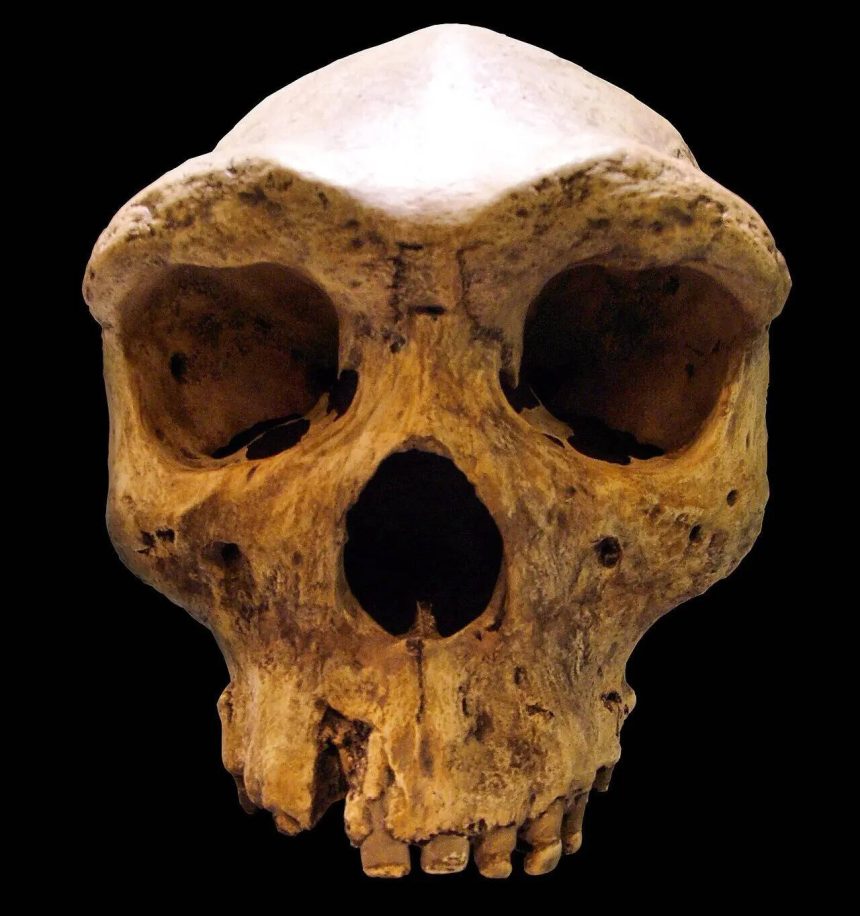
Discovered by a miner’s dynamite blast, the Broken Hill skull is estimated to be around 300,000 years old. Initially thought to be a relic of the early Homo sapiens, the fossil was later classified as a representative of a distinct human species – Homo rhodesiensis. What makes this find so remarkable is its blend of archaic and modern features, defying the conventional notions of human evolution. The skull’s robust build, protruding jaw, and prominent forehead are characteristic of earlier human species, while its brain size and cranial structure hint at a more advanced intelligence.
Scientists have long debated the relationship between early human species, with some positing a linear progression from one to the next. However, the Broken Hill skull throws a wrench into this narrative. It suggests that different human species coexisted, interbred, and influenced each other’s evolution. This complex web of relationships forces us to reevaluate our understanding of human history, acknowledging the nuances and diversities that have shaped our species.
The Coexistence of Human Species
The discovery of the Broken Hill skull has sparked intense debate among scientists, with some hailing it as a missing link between human species. However, others argue that it represents a distinct branch on the human evolutionary tree. Regardless of its classification, the skull’s significance lies in its demonstration of the coexistence of human species in the past. This reality challenges our traditional notions of a single, linear progression from ape to human.
By studying the Broken Hill skull, scientists can gain insights into the social dynamics of early human populations. It is likely that different species coexisted, with some possibly even interbreeding. This complex social landscape would have been shaped by environmental factors, such as climate change and resource competition. The Broken Hill skull serves as a poignant reminder of the intricate web of relationships that underpinned human evolution.
Revisiting the Map of Human Evolution
The Broken Hill skull has been a catalyst for a reevaluation of human evolution. By acknowledging the complexity and diversity of early human species, scientists can refine their understanding of the evolutionary process. This nuanced approach recognizes the agency of individual species, rather than treating them as mere stepping stones in a linear progression.
As we continue to uncover new evidence and refine our understanding of human evolution, the Broken Hill skull remains a vital component of our narrative. Its enigmatic features and complex ancestry invite us to reconsider our assumptions about human history. By embracing the complexity of human evolution, we can develop a more accurate and comprehensive picture of our shared past.
The discovery of the Broken Hill skull in 1921 marked a significant turning point in our understanding of human evolution. Its complex ancestry and blend of archaic and modern features have forced scientists to rethink their assumptions about human history. As we continue to explore the secrets of the Broken Hill skull, we are reminded of the intricate web of relationships that underpinned human evolution. The face of complexity, as we have come to know it, is a testament to the dynamic and multifaceted nature of human history.
“,”excerpt”:”The discovery of a 300,000-year-old human-like skull in Zambia’s Broken Hill has rewritten the map of human evolution, revealing a complex ancestry and challenging traditional linear theories.”,”tags”:[“Human Evolution”,”Ancient Fossils”,”Zambia”,”Broken Hill Skull”,”Homo Rhodiesiensis”],”meta_description”:”The discovery of the Broken Hill skull in Zambia has forced scientists to rethink human evolution, revealing a complex ancestry and challenging traditional linear theories.”}