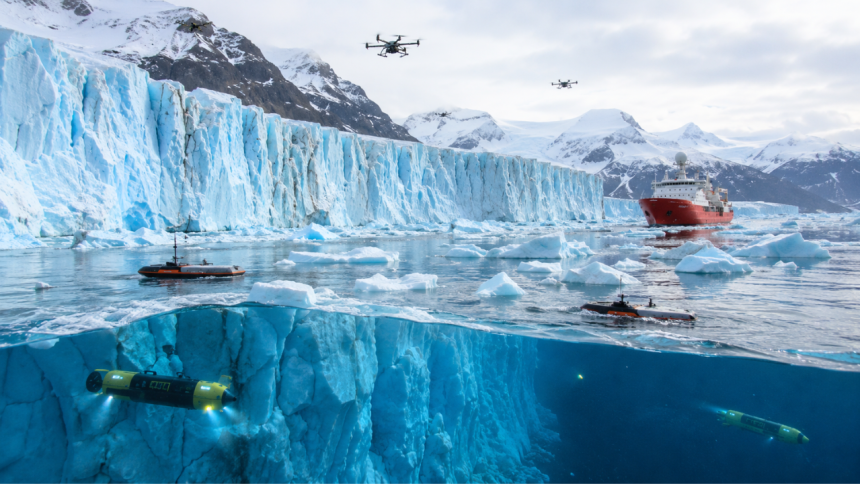
The frozen landscape of Greenland is about to become a testing ground for some of the world’s most advanced robots. This July, an army of autonomous drones, robotic boats, underwater vehicles, and intelligent sensors will embark on an extraordinary expedition to investigate the mysteries of the icy giant’s glaciers. The mission, designed to navigate one of the most inhospitable environments on the planet, aims to uncover the complex interactions between the melting ice and the surrounding ocean. Scientists have long been fascinated by the sheer scale and ferocity of Greenland’s glacial melt, and this ambitious endeavor represents a significant leap forward in our understanding of this critical process.
Robot Armies and the Quest for Data
The robot army, dubbed the ‘Greenland Expeditionary Force,’ will consist of four main components: aerial drones, robotic boats, underwater gliders, and a network of intelligent sensors strategically deployed across the ice sheet. These cutting-edge machines will operate in tandem, gathering a vast array of data that will shed light on the intricate dynamics governing Greenland’s glacial melt. The aerial drones will capture high-resolution images and 3D scans of the ice sheet, while the robotic boats will navigate the fjords and inlets, mapping the complex underwater topography. Meanwhile, the underwater gliders will probe the depths of the ocean, collecting data on ocean currents and the flux of freshwater and heat from the melting ice.
The intelligent sensors, positioned at key locations across the ice sheet, will monitor environmental conditions such as temperature, humidity, and atmospheric pressure. This multi-faceted approach will enable scientists to piece together a comprehensive picture of the complex processes driving Greenland’s glacial melt. By combining data from all these sources, researchers will be able to identify patterns and trends that may have gone undetected through traditional observation methods.
Unraveling the Mysteries of the Iceberg Abyss
One of the primary goals of the Greenland Expeditionary Force is to investigate the phenomenon of ‘calving,’ where massive chunks of ice break off from the glaciers and plunge into the ocean. Scientists believe that calving is a crucial component of Greenland’s glacial melt, but the exact mechanisms driving this process remain poorly understood. The robotic boats and underwater gliders will provide critical data on the calving process, while the aerial drones will offer a bird’s-eye view of the ice sheet’s surface. By analyzing this data, researchers hope to uncover new insights into the complex interactions between the ice sheet and the ocean.
Another key aspect of the expedition is the deployment of intelligent sensors to monitor changes in the ice sheet’s surface. These sensors will track the movement of icebergs, the formation of crevasses, and the development of ‘moulins,’ which are vertical shafts that form in the ice when surface meltwater seeps through the ice sheet. By monitoring these changes in real-time, scientists will be able to better understand the dynamics governing Greenland’s glacial melt and identify potential tipping points that could accelerate the process.
The Future of Climate Research
The Greenland Expeditionary Force represents a significant step forward in our understanding of the Earth’s climate system. By leveraging cutting-edge robotics and advanced data analysis techniques, scientists will be able to unravel the mysteries of Greenland’s glacial melt and shed light on the complex interactions between the ice sheet and the ocean. The insights gained from this expedition will have far-reaching implications for our understanding of climate change and will inform the development of more effective strategies for mitigating its impacts.
As the robot army sets off for Greenland, scientists are eager to unlock the secrets of the iceberg abyss. This extraordinary expedition represents a major milestone in the quest to understand the intricate dynamics governing our planet’s climate system. By combining cutting-edge robotics with advanced data analysis techniques, researchers will be able to gain a deeper understanding of the complex processes driving Greenland’s glacial melt, and in doing so, they will take a significant step forward in the pursuit of climate knowledge.