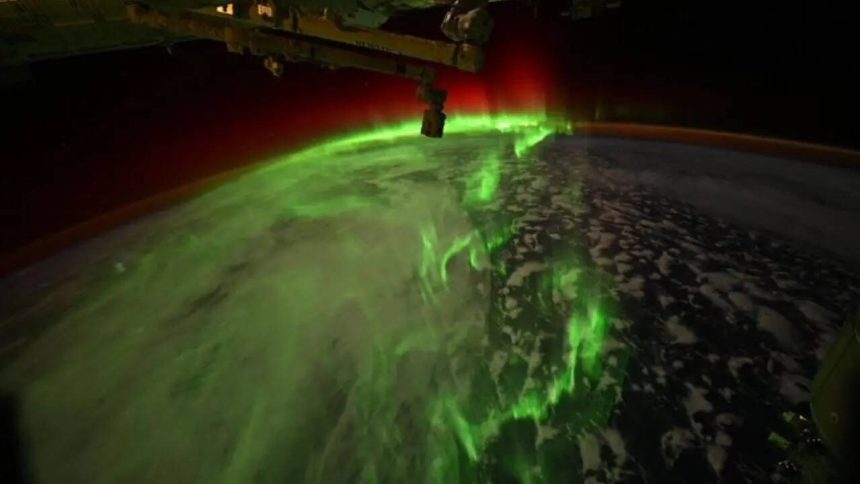
As the Earth prepares to face a strong geomagnetic storm on June 8, astronomers are abuzz with excitement about a rare phenomenon that could be visible from parts of India – the breathtaking display of the Aurora Borealis. A Coronal Mass Ejection (CME) from the Sun has set off a chain reaction, prompting the US National Oceanic and Atmospheric Administration (NOAA) to issue a G3 (Strong) geomagnetic storm watch. This rare alignment of celestial events is poised to captivate skywatchers, and scientists are eager to unravel the intricacies of this spectacular display.
Unlocking the Secrets of the Aurora
The Aurora Borealis, also known as the Northern Lights, is a natural light display that occurs when charged particles from the Sun interact with the Earth’s magnetic field and atmosphere. This phenomenon is usually visible in the Arctic and sub-Arctic regions, but the strong geomagnetic storm on June 8 is expected to extend its visibility to parts of India, particularly in the northern and eastern regions. The exact timing and duration of the display are still uncertain, but scientists are working tirelessly to provide updates and predictions.
Researchers at the Indian Institute of Astrophysics (IIA) are closely monitoring the situation, using advanced computer models to simulate the behavior of the geomagnetic storm. Their findings suggest that the display will be most intense in the early hours of June 8, with the possibility of it lingering until dawn. While the exact location and duration of the display are still unclear, one thing is certain – this rare event will offer a once-in-a-lifetime opportunity for skywatchers in India to witness the breathtaking beauty of the Aurora.
What to Expect from the Aurora Display
According to scientists, the Aurora display on June 8 will be characterized by vibrant colors, with shades of green, blue, and even red visible in the night sky. The display will be most intense near the magnetic poles, where the Earth’s magnetic field is strongest. In India, this means that the northern and eastern regions will be the most likely to witness the spectacle. However, the display may also be visible in other parts of the country, depending on the intensity of the geomagnetic storm.
As the charged particles from the Sun interact with the Earth’s atmosphere, they will excite the atoms and molecules, causing them to emit light at various wavelengths. This process will create a kaleidoscope of colors, with the intensity and duration of the display depending on the strength of the geomagnetic storm. While it is impossible to predict the exact outcome, one thing is certain – this rare event will be a once-in-a-lifetime experience for skywatchers in India.
The Significance of the Aurora Display
The Aurora display on June 8 is not just a spectacular sight – it also holds significant scientific value. By studying the behavior of the geomagnetic storm and its impact on the Earth’s atmosphere, scientists can gain a deeper understanding of the complex interactions between the Sun, the Earth’s magnetic field, and the atmosphere. This knowledge can have far-reaching implications for our understanding of space weather and its effects on our daily lives.
As the Earth prepares to face the strong geomagnetic storm, scientists are eagerly awaiting the spectacle that is about to unfold. With the possibility of the Aurora display being visible from parts of India, this event is poised to captivate skywatchers and scientists alike. Whether you are an astronomy enthusiast or simply someone who appreciates the beauty of nature, this rare event is not to be missed.