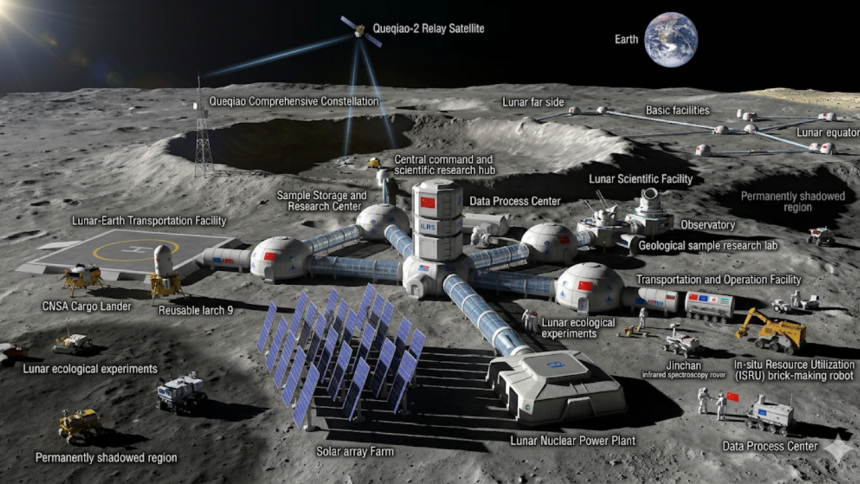
As the world’s space agencies continue to push the boundaries of lunar exploration, China’s ambitious plans to establish a permanent base on the moon are gaining momentum. While NASA’s Artemis program aims to return humans to the lunar surface by 2025, China’s International Lunar Research Station (ILRS) program, in collaboration with Russia, is rapidly advancing its goals to construct an operational research facility at the South Pole of the moon. The ILRS program’s unprecedented pace is not only exerting pressure on the US space program but also redefining the future direction of moon exploration.
China’s Lunar Ambitions: A Collaborative Effort
The ILRS program is a testament to China’s unwavering commitment to lunar exploration, with the country’s space agency, CNSA, leading the charge in collaboration with its Russian counterpart, Roscosmos. By pooling resources and expertise, the two nations are working towards a common goal: to establish a sustainable presence on the moon. The ILRS program’s focus on the South Pole of the moon is driven by its unique advantages, including the presence of water ice, which can be used as a resource for life support, propulsion, and in-situ resource utilization.
China has already made significant strides in developing the necessary technologies to support its lunar ambitions. The country’s recent missions, including the Chang’e 4 and Chang’e 5, have successfully demonstrated its capabilities in landing on the moon and returning lunar samples to Earth. These missions have also tested critical technologies, such as lunar surface communication and navigation systems, which will be essential for the ILRS program’s success.
The Pressure is On: A New Era in Lunar Competition
The ILRS program’s rapid progress is putting pressure on NASA’s Artemis program, which aims to return humans to the lunar surface by 2025. While NASA has made significant strides in developing its Space Launch System (SLS) rocket and Orion spacecraft, its timeline is facing challenges due to recent setbacks and delays. The competition between China and the US in lunar exploration is heating up, with both nations investing heavily in their respective programs. The stakes are high, with the winner claiming a significant advantage in the space race.
The ILRS program’s focus on a sustainable presence on the moon is also forcing NASA to rethink its strategy. While the US agency has traditionally focused on short-term missions, the ILRS program’s long-term goals are pushing it to consider new approaches to lunar exploration. This includes the development of new propulsion systems, life support technologies, and in-situ resource utilization capabilities, all of which will be essential for a sustainable presence on the moon.
The Future of Lunar Exploration: A New Era Dawns
The ILRS program’s rapid progress is marking a new era in lunar exploration, with China and Russia leading the charge. As the world’s space agencies continue to push the boundaries of what is possible, the future of lunar exploration is becoming increasingly clear. With private companies like SpaceX and Blue Origin also entering the fray, the competition is heating up, and the stakes are higher than ever. The moon, once a distant and inhospitable world, is now a hub of activity, with nations and companies vying for a piece of the lunar pie.
As the world watches this new era in lunar exploration unfold, one thing is clear: the moon is no longer just a stepping stone for deeper space exploration, but a destination in its own right. The ILRS program’s success will not only mark a new era in lunar exploration but also redefine the future direction of space travel.
As we look to the future, one thing is certain: the moon will play an increasingly important role in humanity’s quest for knowledge and exploration. And with China’s ILRS program leading the charge, we can expect a new era of innovation and discovery to unfold in the years to come.