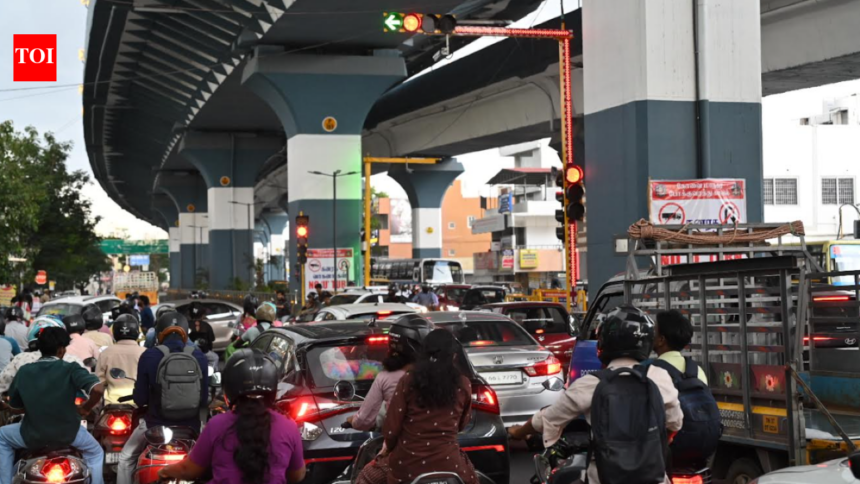
The city of Coimbatore recently witnessed a peculiar experiment in traffic management on the Avinashi Road, where trial traffic signals were installed at two crucial junctions – ESSO Bunk and Pioneer Mill. The novel approach aimed to reduce congestion and streamline the flow of traffic. However, it appears that the experiment has not gone as planned, with commuters experiencing heavy congestion and frustration.
Disastrous Experiment Leaves Commuters Frustrated
The trial traffic signals, which were set up to manage the flow of traffic, have instead created a nightmare for commuters. The signals, which were designed to prioritize certain lanes and prevent U-turns, have resulted in a massive buildup of traffic. The congestion has been particularly severe during peak hours, causing commuters to waste valuable time and fuel.
Commuters have expressed their frustration on social media, with many calling for the removal of the trial signals. They have reported long queues of traffic, increased travel times, and even accidents due to the congestion. The situation has been exacerbated by the fact that the signals have created confusion among drivers, leading to a decrease in productivity and an increase in stress levels.
U-Turn System: A Better Alternative?
After reviewing the situation, the city police have decided to revert to the traditional U-turn system at the two junctions. This move has been welcomed by commuters, who are relieved that the chaos has been brought to an end. The U-turn system, which allows drivers to turn back at designated points, has been shown to be more efficient and effective in managing traffic flow.
The police have attributed the failure of the trial traffic signals to a lack of planning and coordination. They have promised to work with stakeholders to ensure that any future experiments are better planned and executed. In the meantime, commuters can breathe a sigh of relief as the U-turn system is put back in place.
The Way Forward
The failure of the trial traffic signals has provided a valuable lesson for the city police and traffic planners. It highlights the importance of careful planning and coordination when introducing new traffic management systems. The police must now focus on improving traffic flow and reducing congestion, while also engaging with commuters to ensure that their needs are met.
In the coming weeks and months, the city police will work to implement effective traffic management strategies that prioritize the needs of commuters. This may involve introducing new technologies, such as smart traffic signals, or reconfiguring the layout of roads to improve traffic flow. Whatever the approach, one thing is certain: the city of Coimbatore will continue to evolve and adapt to the changing needs of its citizens.
The city’s commuters are hoping that the police will learn from the mistakes of the past and introduce more effective traffic management systems in the future. Only time will tell if the city will be able to achieve this goal, but one thing is certain: the city’s residents are eager for a smoother and more efficient commute.
The city of Coimbatore has much to learn from this experiment, and it is clear that the police and traffic planners will do everything in their power to ensure that commuters are not inconvenienced in the future. As the city continues to grow and evolve, it will be interesting to see how it adapts to the changing needs of its citizens.