The wait is almost over for thousands of eclipse enthusiasts who have been planning their trip to Spain for years, all in anticipation of the highly anticipated total solar eclipse on 12 August 2026. This rare and awe-inspiring phenomenon promises to be one of Europe’s most significant astronomical events in decades, drawing in amateur astronomers, photographers, and tourists from every corner of the globe. As the big day approaches, however, concerns are growing that many of these eager travelers may inadvertently miss the main event, due to a combination of factors that could put their viewing plans at risk.
Understanding the Eclipse
The total solar eclipse is a rare and awe-inspiring phenomenon in which the Moon passes directly between the Earth and the Sun, blocking the Sun’s light and revealing the Sun’s ethereal corona. This spectacle will be visible from a narrow band of territories, with Spain being one of the most accessible and desirable locations for viewing. The path of totality, as it is known, will sweep across the country, offering a mere 2 minutes and 20 seconds of totality, during which time the sky will darken, stars will appear, and the air will grow cooler.
Despite the short duration of the eclipse, the experience promises to be an unforgettable one, with many enthusiasts willing to travel vast distances and endure significant hardships in order to witness this natural wonder. However, with great enthusiasm comes great risk, as the sheer number of people flocking to Spain could put a strain on local infrastructure, potentially disrupting the travel plans of even the most seasoned eclipse chasers.
Eclipse Chasers at Risk
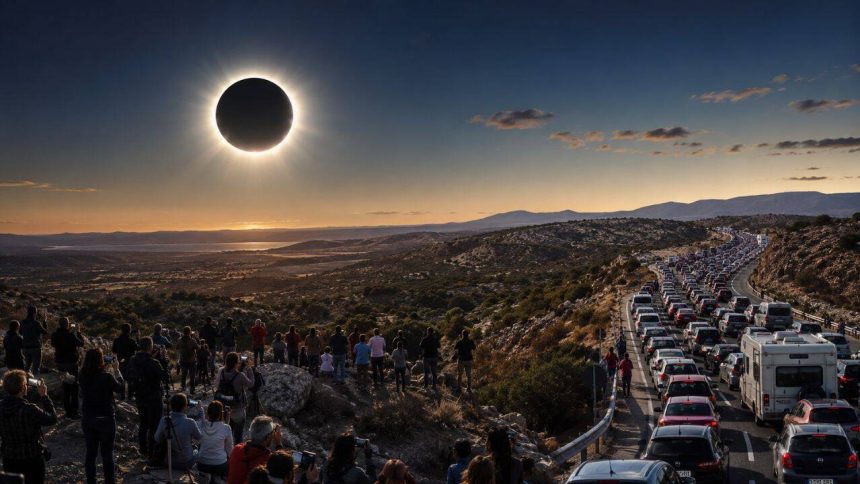
One of the primary concerns facing eclipse enthusiasts is the risk of over-tourism, which could lead to overcrowding, traffic congestion, and accommodation shortages. Many popular viewing locations, such as national parks and scenic viewpoints, may become overwhelmed by the sheer number of people, making it difficult for travelers to secure a good vantage point. Furthermore, the limited window of totality means that even the slightest delay or disruption could cause viewers to miss the eclipse entirely.
In addition to these logistical challenges, there are also concerns about the weather, which could potentially ruin the viewing experience. Cloud cover, in particular, poses a significant threat, as even a thin layer of cloud can block the view of the eclipse. With Spain’s notoriously unpredictable summer weather, there is a very real risk that many travelers may find their views obscured by cloud, leaving them with nothing but a faint memory of an event they had traveled so far to see.
Planning and Preparation
In order to mitigate these risks and ensure a successful viewing experience, it is essential for eclipse enthusiasts to plan and prepare carefully. This includes booking accommodations and transportation well in advance, as well as researching potential viewing locations and their accessibility. It is also crucial to stay up-to-date with the latest weather forecasts and be prepared for any eventuality, whether it be cloud cover or unexpected crowds.
As the total solar eclipse draws near, the excitement and anticipation are palpable, but so too are the risks and uncertainties. By being aware of these potential pitfalls and taking steps to prepare, eclipse chasers can minimize their chances of missing this once-in-a-lifetime event and ensure that their experience is nothing short of unforgettable. With careful planning, a flexible attitude, and a dash of good fortune, thousands of travelers will be able to witness the awe-inspiring beauty of the total solar eclipse and take home memories that will last a lifetime.