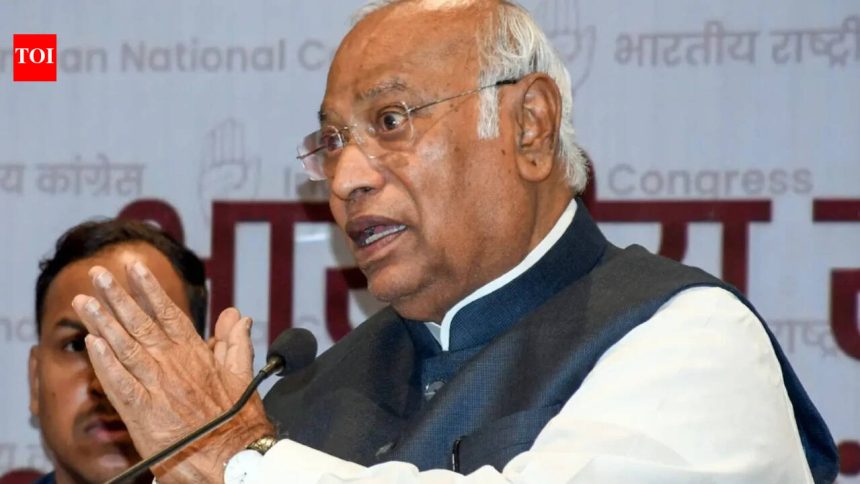
The Election Commission of India (ECI) has taken a serious note of the derogatory remark made by Congress chief Mallikarjun Kharge against Prime Minister Narendra Modi, sparking a heated debate in the country’s political landscape. In a stern notice issued to Kharge, the EC has sought a response within 24 hours, indicating that the matter is being treated with utmost gravity. The development has raised questions about the limits of free speech in the country and the role of the EC in maintaining electoral integrity.
Kharge’s ‘Terrorist’ Remark Sparks Outrage
Kharge’s comment, made during a public rally in poll-bound Karnataka, has been widely condemned by various quarters, including the ruling Bharatiya Janata Party (BJP) and several opposition parties. The Congress chief’s remark was seen as a deliberate attempt to polarize voters along communal lines, and the EC’s move reflects its commitment to upholding the principles of electoral integrity and maintaining a level-playing field for all contesting parties. The notice issued to Kharge is a clear indication that the EC will not tolerate any attempts to disrupt the electoral process through inflammatory or divisive rhetoric.
The EC’s action has been welcomed by several civil society groups and election observers, who have hailed the move as a significant step towards ensuring that the upcoming polls are conducted in a fair and peaceful manner. The development has also sparked a heated debate about the role of politicians in perpetuating divisive narratives and the need for greater accountability in the electoral process.
EC’s Decision: A Test of Constitutional Authority
The Election Commission’s decision to issue a notice to Kharge has raised important questions about the limits of its authority in regulating election-related discourse. While the EC has the power to take action against politicians who violate the Model Code of Conduct, the extent of its jurisdiction in this regard is often subject to interpretation. The notice issued to Kharge is seen as a test of the EC’s resolve to uphold the Constitution and ensure that the electoral process is not compromised by inflammatory or divisive rhetoric.
The controversy surrounding Kharge’s remark has also highlighted the need for greater transparency and accountability in election-related matters. The EC’s decision to issue a notice to Kharge has set a precedent for similar actions against politicians who engage in similar conduct, and it remains to be seen how this will play out in the coming weeks and months.
Way Forward: Electoral Integrity and Free Speech
The EC’s notice to Kharge has sparked a heated debate about the balance between electoral integrity and free speech in the country. While the EC has the right to regulate election-related discourse, it must also ensure that it does not stifle legitimate expression or infringe upon fundamental rights. The way forward will require a nuanced approach that balances the need to maintain electoral integrity with the need to protect free speech and uphold the Constitution.
The EC’s decision to issue a notice to Kharge is a significant development in the country’s electoral landscape, and it remains to be seen how this will impact the upcoming polls. As the country inches closer to the next general elections, the need for greater transparency, accountability, and electoral integrity has never been more pressing. The EC’s notice to Kharge has set a precedent for similar actions against politicians who engage in similar conduct, and it is hoped that this will lead to a more inclusive and respectful electoral process.