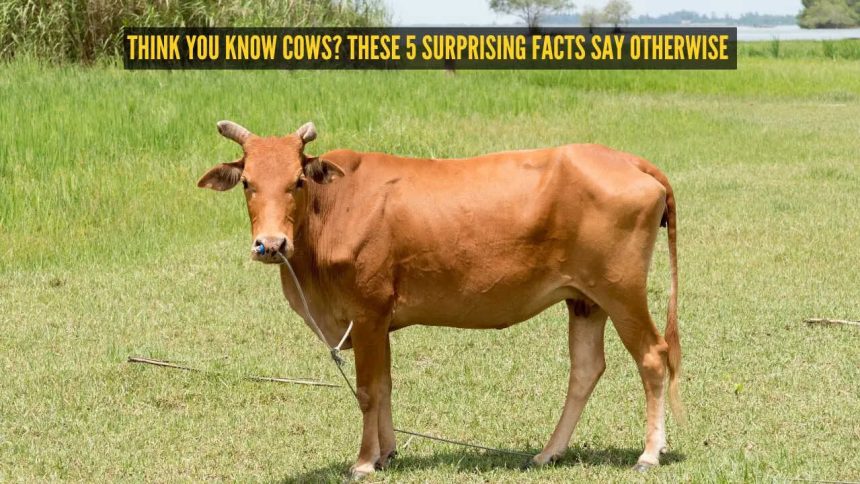
When was the last time you looked at a cow and thought, “There’s probably something surprising about this animal”? Probably never. They’re so common that it’s easy to assume we know everything there is to know about them. But the more scientists study cows, the more unexpected discoveries emerge. From remembering faces to forming close friendships, these gentle animals have abilities that often go unnoticed. As we gaze out at a herd of cows grazing in a green meadow, we rarely consider the intricate social dynamics at play or the complex cognitive processes that govern their behavior. Yet, beneath their placid exterior, cows are revealing themselves to be fascinating creatures, full of surprises and contradictions.
The Intelligent Socialites
One of the most striking aspects of cow behavior is their intelligence and social complexity. Cows are able to recognize and remember individual members of their herd, as well as humans they interact with. They have been observed displaying signs of affection, such as licking and nuzzling, towards their favorite companions. This social bonding is not limited to casual interactions; cows have been known to form long-lasting friendships, often with preferred partners they seek out in times of stress or uncertainty. These relationships are built on trust, mutual support, and a deep understanding of each other’s personalities and quirks.
But cows are not just social creatures; they are also highly intelligent animals, capable of solving problems and adapting to new situations. In experiments, cows have demonstrated an ability to learn and remember complex routes and navigation systems, as well as to recognize and respond to different sounds and visual cues. This cognitive flexibility is essential for their survival, allowing them to navigate their environment, find food and water, and avoid predators.
Emotional Lives and Communication
Cows are also emotional creatures, with a range of feelings and sensations that are essential to their well-being. They are capable of experiencing joy, fear, excitement, and even nostalgia, and they communicate these emotions through a variety of vocalizations, body language, and physical expressions. A cow’s moos can convey different meanings, from a contented lowing to a distressed bellow, and they use these vocalizations to convey information, express needs, and connect with others. They also use body language to communicate, such as ear and tail positions, to signal friendliness, aggression, or submission.
But perhaps the most surprising aspect of cow communication is their ability to recognize and respond to individual voices. In one study, cows were able to distinguish between the voices of their owners and strangers, and they responded differently to each. This level of auditory recognition is rare in the animal kingdom, and it highlights the complexity and sophistication of cow social behavior. By recognizing individual voices, cows are able to build trust and intimacy with their human caregivers, and they are better able to navigate their social environment.
Reevaluating Our Relationship with Cows
As we learn more about the secret lives of cows, we are forced to reevaluate our relationship with these animals. For too long, cows have been viewed as nothing more than commodities, raised for their milk and meat without consideration for their emotional or social needs. But as we recognize their intelligence, social complexity, and emotional depth, we are compelled to reconsider our treatment of them. By providing cows with more natural living conditions, social interaction, and mental stimulation, we can improve their welfare and promote more humane and sustainable farming practices.
As we gaze out at a herd of cows, we are no longer just seeing passive creatures; we are seeing individuals with their own unique personalities, social relationships, and emotional experiences. We are seeing animals that are capable of joy, friendship, and love, and that are deserving of our respect, compassion, and care. By embracing this new understanding of cows, we can build a more empathetic and sustainable relationship with these incredible creatures, and we can work towards a future where they are valued and treated with the dignity they deserve.