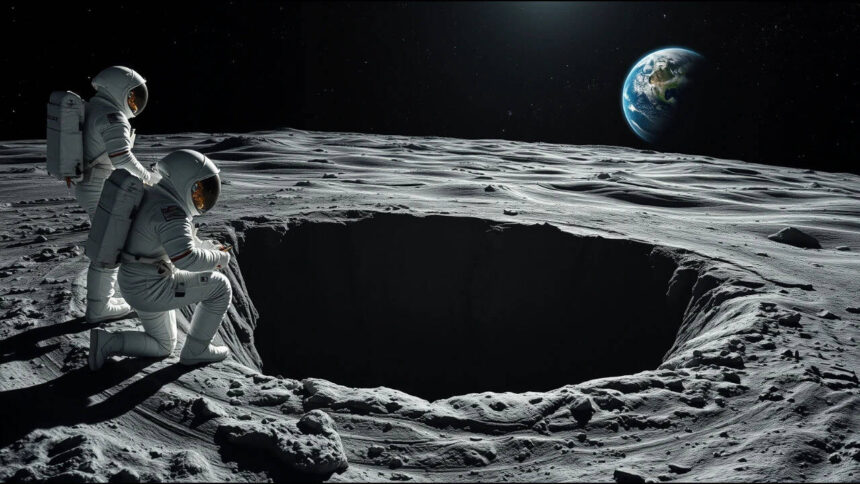
The Moon, Earth’s closest celestial neighbor, has long been a subject of fascination for scientists and space enthusiasts alike. Recent discoveries have hinted at the presence of significant water ice deposits beneath the permanently shadowed craters near the Moon’s south pole. However, these deposits have proven difficult to detect using current orbital instruments, leaving researchers to wonder if they are truly there. A new study, led by a team of scientists from the University of Maryland, Lawrence Berkeley National Laboratory, and the University of Hawaii, proposes a novel approach to finding these hidden ice reserves by listening for the unique seismic waves that pass through frozen versus dry lunar soil.
Understanding Seismic Waves
Seismic waves, the same vibrations recorded during earthquakes on Earth, are a crucial tool in understanding the internal structure of celestial bodies. By analyzing how these waves change as they pass through different materials, scientists can gain valuable insights into the composition and properties of the Moon’s subsurface. The researchers behind the new study believe that by using seismic waves, they can detect the presence of water ice on the Moon, even if it is buried beneath the surface. This approach has the potential to revolutionize our understanding of the Moon’s geology and could have significant implications for future lunar missions.
The concept of using seismic waves to detect water ice on the Moon is based on the principle that frozen soil has a distinct seismic signature compared to dry soil. When seismic waves pass through frozen soil, they travel at a slower speed and with a higher amplitude than when they pass through dry soil. By measuring these changes, scientists can infer the presence of water ice, even if it is hidden from view. The researchers have developed sophisticated computer models to simulate the seismic waves and test their hypothesis, with promising results.
Implications for Lunar Exploration
The discovery of water ice on the Moon has significant implications for future lunar missions. Water ice can be used as a source of oxygen, life support, and propulsion, making it a vital resource for sustained human presence on the Moon. The ability to detect and extract water ice could enable the establishment of permanent lunar bases, facilitating scientific research, exploration, and development of the Moon’s resources. Furthermore, the presence of water ice on the Moon could also provide insights into the Moon’s geological history and the formation of the solar system.
The new detection method proposed by the researchers has the potential to greatly enhance our understanding of the Moon’s water ice reserves. By combining seismic data with other datasets, such as orbital imagery and laser altimetry, scientists can create detailed maps of the Moon’s subsurface, revealing the location and extent of water ice deposits. This information will be crucial for planning future lunar missions, including the selection of landing sites and the development of strategies for extracting and utilizing the water ice.
Future Directions
The study’s findings have significant implications for the future of lunar exploration and the search for water ice on the Moon. The researchers are already planning to test their hypothesis using data from upcoming lunar missions, such as the NASA’s Artemis program, which aims to return humans to the Moon by 2024. The ability to detect water ice using seismic waves could also be applied to other celestial bodies, such as Mars and asteroids, where water ice is believed to be present. As scientists continue to explore and understand the Moon’s subsurface, they may uncover new and exciting secrets about our closest celestial neighbor.
The discovery of a new method for detecting hidden water ice on the Moon is a testament to human ingenuity and the boundless curiosity that drives us to explore and understand the universe. As we continue to push the boundaries of what is possible, we may uncover new and exciting secrets about the Moon and the solar system, inspiring future generations to reach for the stars. With the new detection method, scientists are one step closer to unlocking the secrets of the Moon’s hidden ice reserves, and the possibilities for future lunar exploration are endless.