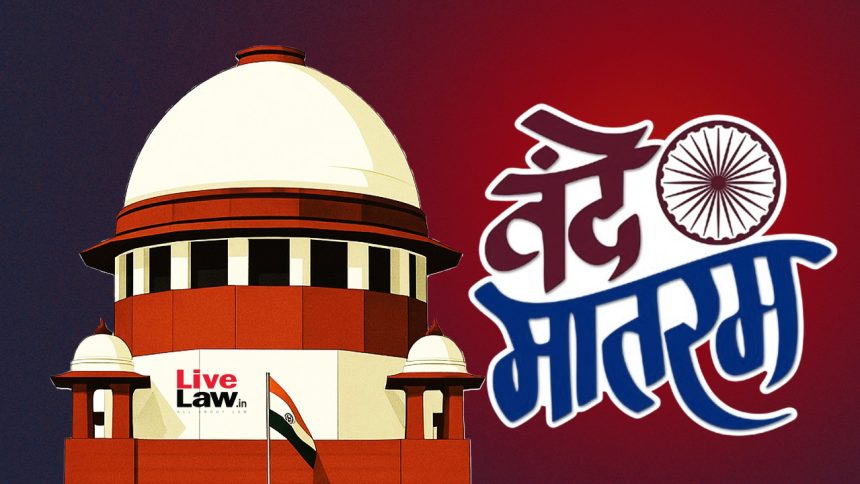
The Supreme Court’s recent decision to reject a plea against the Ministry of Home Affairs’ circular on Vande Mataram has ignited a fierce debate on patriotism, free speech, and the role of the government in promoting national unity. The Court’s observation that the petition was premature and based on vague apprehensions has left many wondering about the implications of this ruling on the country’s social fabric. As the nation grapples with the complexities of patriotism and individual freedom, one thing is clear: the Vande Mataram controversy is far from over.
Understanding the Context
The Ministry of Home Affairs’ circular had sparked concerns among certain sections of society, who felt that the promotion of Vande Mataram could be used to impose a particular brand of patriotism on citizens. The petitioners had argued that this could lead to a penalty for those who refused to sing the song, thereby infringing on their right to free speech and expression. However, the Supreme Court’s decision has put these concerns to rest, at least for the time being. The Court’s emphasis on the absence of a penalty for not singing Vande Mataram has reassured many that the government is not attempting to coerce citizens into a particular form of patriotism.
But the question remains: what does it mean to be patriotic in a diverse and plural society like India? Is singing Vande Mataram a necessary expression of patriotism, or can it be seen as a form of cultural imposition? These are complex questions that require a nuanced understanding of the country’s history, culture, and values. As the debate rages on, it is essential to recognize that patriotism is not a one-size-fits-all concept, and that individual freedoms and cultural sensitivities must be respected and protected.
Implications and Reactions
The Supreme Court’s decision has been met with a mix of reactions from across the political spectrum. While some have welcomed the ruling as a victory for patriotism and national unity, others have expressed disappointment and concern about the potential implications for free speech and minority rights. The fact that the Court has not ruled out the possibility of future challenges to the MHA circular has left many wondering about the long-term implications of this decision. As the country moves forward, it is essential to ensure that the promotion of patriotism and national unity does not come at the cost of individual freedoms and cultural diversity.
The Vande Mataram controversy has also sparked a wider debate about the role of the government in promoting patriotism and national unity. While some argue that the government has a responsibility to promote a sense of national pride and unity, others believe that this should be left to individual citizens and civil society organizations. As the government navigates this complex issue, it is essential to recognize that patriotism is not just about singing a song or following a particular ritual, but about promoting a sense of shared values and common purpose.
Looking Ahead
As the nation moves forward from this controversy, it is essential to recognize that the debate over Vande Mataram is not just about a song, but about the values and principles that underlie our democracy. The Supreme Court’s decision has provided a temporary resolution to the issue, but it is up to citizens, civil society organizations, and the government to ensure that the promotion of patriotism and national unity is done in a way that respects individual freedoms and cultural diversity. This requires a nuanced understanding of the complex issues at play and a willingness to engage in open and respectful dialogue. Ultimately, the Vande Mataram controversy has highlighted the need for a more inclusive and nuanced understanding of patriotism, one that recognizes the diversity and complexity of Indian society.
The road ahead will not be easy, and there will be many challenges to navigate. But as the nation looks to the future, it is essential to remember that patriotism is not a fixed or static concept, but a dynamic and evolving idea that must be shaped by the values and principles of our democracy. By engaging in open and respectful dialogue, and by recognizing the diversity and complexity of Indian society, we can work towards a more inclusive and nuanced understanding of patriotism, one that promotes national unity and respect for individual freedoms.
The Vande Mataram controversy may be over for now, but its implications will be felt for a long time to come. As we move forward, it is essential to recognize that the promotion of patriotism and national unity is not a zero-sum game, where one side wins and the other loses. Rather, it is a complex and nuanced issue that requires a deep understanding of the values and principles that underlie our democracy. By working together and engaging in open and respectful dialogue, we can build a more inclusive and patriotic India, one that respects individual freedoms and promotes national unity.