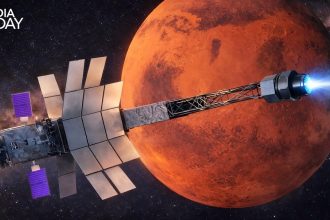
Imagine a spacecraft that can travel to Mars and beyond, powered by a compact nuclear reactor that provides a nearly limitless source of energy. This is no longer the stuff of science fiction, thanks to NASA’s innovative Space Reactor 1 Freedom spacecraft. With its cutting-edge nuclear electric propulsion (NEP) technology, this spacecraft is poised to revolutionize the way we explore our solar system.
Unlocking the Potential of Nuclear Power
The Space Reactor 1 Freedom spacecraft is a significant leap forward in space exploration, as it harnesses the power of nuclear energy to propel itself through the vast distances of space. By utilizing a nuclear reactor, the spacecraft can generate a substantial amount of electricity, which is then used to power an electric propulsion system. This approach offers several advantages over traditional chemical propulsion systems, including greater efficiency, longer mission durations, and increased payload capacity.
The use of nuclear power also enables the spacecraft to operate for extended periods, making it an ideal choice for missions to Mars and other distant planets. With a reliable source of energy, the spacecraft can conduct a wide range of scientific experiments, transmit valuable data back to Earth, and even support human exploration. The implications are profound, as nuclear power could become the backbone of future space missions, enabling us to explore the cosmos like never before.
Navigating the Challenges of Nuclear Spacecraft
While the concept of a nuclear-powered spacecraft is exciting, it also presents several challenges that must be addressed. One of the primary concerns is safety, as nuclear reactors pose a risk of radiation exposure to both the crew and the environment. To mitigate this risk, NASA has developed advanced shielding technologies and safety protocols to ensure the safe operation of the reactor. Additionally, the reactor is designed to be highly compact and efficient, minimizing the amount of nuclear material required.
Another challenge is the development of a reliable and efficient electric propulsion system. NASA has been working on advanced ion engines and Hall effect thrusters, which offer high specific impulse and fuel efficiency. These systems are designed to work in tandem with the nuclear reactor, providing a high degree of maneuverability and flexibility. By overcoming these technical hurdles, NASA can unlock the full potential of nuclear power in space exploration.
A New Era of Space Exploration
The Space Reactor 1 Freedom spacecraft represents a major milestone in the development of nuclear electric propulsion technology. As NASA continues to push the boundaries of space exploration, this technology will play an increasingly important role in enabling missions to Mars, the outer planets, and beyond. With its high specific impulse and fuel efficiency, NEP technology could also enable the development of advanced spacecraft that can travel to the outer reaches of the solar system and even into interstellar space.
The significance of this achievement cannot be overstated, as it has the potential to revolutionize the way we explore and understand our universe. By harnessing the power of nuclear energy, we can embark on more ambitious missions, conduct more complex scientific experiments, and expand our presence in space. As we look to the future, it is clear that nuclear power will play a vital role in shaping the next generation of space exploration.
The future of space travel is looking brighter than ever, and NASA’s Space Reactor 1 Freedom spacecraft is at the forefront of this exciting new era. As we continue to push the boundaries of what is possible, we can expect to see even more innovative technologies emerge, enabling us to explore the cosmos in ways we never thought possible. With nuclear power leading the charge, the possibilities are endless, and the next great leap for humanity is just around the corner.