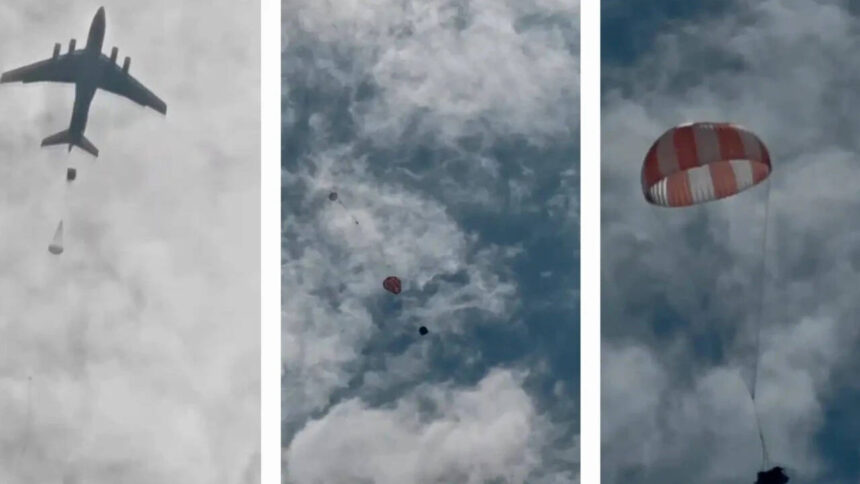
The Indian Space Research Organisation (Isro) has achieved a significant milestone in its Gaganyaan mission, completing the fifth Integrated Main Parachute Airdrop Test (IMAT-05). This crucial test has qualified the crew module’s main parachute system to withstand the maximum expected loads during descent, paving the way for the first uncrewed Gaganyaan mission. The successful test is a testament to Isro’s relentless pursuit of excellence in space technology and its commitment to ensuring the safety of future astronauts.
Gaganyaan Mission Overview
The Gaganyaan mission is India’s ambitious human spaceflight program, aimed at sending astronauts to space by 2023. The program involves several critical components, including the development of a crew module, a service module, and a launch vehicle. The crew module is designed to carry astronauts to space and bring them back safely, and the parachute system is a vital part of this process. The main parachute system is responsible for slowing down the crew module during its descent, ensuring a safe landing for the astronauts.
The IMAT-05 test was conducted to validate the performance of the main parachute system under various conditions. The test involved dropping the parachute system from an aircraft and measuring its performance during descent. The results of the test have been encouraging, with the parachute system performing as expected and withstanding the maximum expected loads. This milestone has brought Isro one step closer to realizing its dream of sending astronauts to space.
Parachute System Development
The development of the parachute system has been a challenging task for Isro. The system requires a high degree of precision and reliability, as it is responsible for ensuring the safety of the astronauts. Isro has been working on the development of the parachute system for several years, and the IMAT-05 test is a culmination of this effort. The test has validated the design and performance of the parachute system, and Isro is now confident of its ability to withstand the stresses of spaceflight.
The parachute system consists of several components, including the main parachute, the drogue parachute, and the pilot parachute. The main parachute is the largest and most critical component, responsible for slowing down the crew module during its descent. The drogue parachute is used to stabilize the crew module, while the pilot parachute is used to deploy the main parachute. The development of these components has required significant research and testing, and Isro has had to overcome several technical challenges to achieve the desired level of performance.
Future Plans and Expectations
With the IMAT-05 test completed, Isro is now gearing up for the first uncrewed Gaganyaan mission. The mission is expected to be launched later this year, and it will involve the launch of a crew module into space. The crew module will be equipped with a dummy astronaut and will be designed to test the performance of the parachute system and other critical components. The success of this mission will pave the way for the first crewed Gaganyaan mission, which is expected to be launched in 2023.
The Gaganyaan mission is a significant milestone in India’s space program, and it is expected to have a major impact on the country’s space capabilities. The mission will demonstrate India’s ability to launch astronauts into space and bring them back safely, and it will pave the way for future human spaceflight missions. Isro is confident of its ability to achieve this milestone, and the successful completion of the IMAT-05 test has brought the organization one step closer to realizing its dream of sending astronauts to space. As India prepares to launch its first astronauts into space, the world is watching with bated breath, eager to see the country achieve this historic milestone.