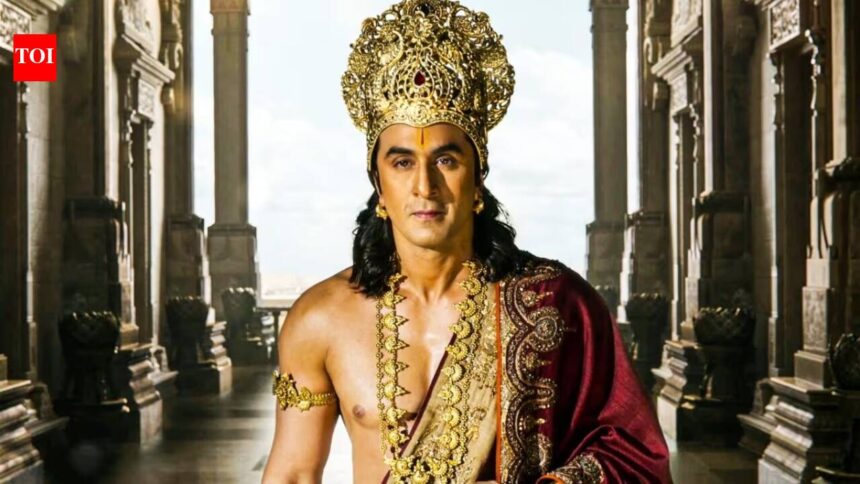
The recent trailer release of Nitesh Tiwari’s ‘Ramayana: Part 1’ has sparked a lively online discussion, with many viewers expressing their opinions on the film’s casting choices and the overall approach to telling the iconic mythological tale. At the center of this debate is actor Ranbir Kapoor, who plays the lead role of Lord Ram in the movie. In a recent response to the criticism, Kapoor shed light on the subjective nature of depicting a character as revered as Lord Ram, and the difficulties that come with bringing such a figure to life on the big screen.
First Section: Interpreting Lord Ram
Kapoor’s words of wisdom on the casting controversy serve as a poignant reminder that the character of Lord Ram is not a one-dimensional figure, but rather a complex and multifaceted individual whose image has been interpreted and reinterpreted across cultures, traditions, and time. As Kapoor astutely pointed out, ‘All the people have their own interpretation of Lord Ram. There’s no fixed face to it.’ This statement highlights the inherent challenge of capturing the essence of a character who has been depicted in countless ways throughout history, from the majestic statues of Ayodhya to the animated depictions of children’s books.
The actor’s observation also underscores the significance of artistic freedom and creative expression in bringing this timeless tale to life. With a rich cultural heritage at its core, ‘Ramayana: Part 1’ is not just a film, but a cultural phenomenon that has the potential to transcend generations and borders. By embracing this diversity, the makers of the film have taken a bold step towards reimagining the classic epic for a modern audience.
Second Section: Challenges of Portraying a Historical Figure
Portraying a character as revered as Lord Ram comes with its own set of challenges, particularly in terms of authenticity and sensitivity. Kapoor’s response also touches upon the importance of understanding the historical context and cultural nuances that surround the character. ‘Ramayana’ is a story that has been passed down through generations, and its significance extends far beyond the confines of a single film or adaptation.
The pressure of living up to the audience’s expectations is immense, especially when it comes to depicting a figure who is deeply ingrained in the cultural psyche. Kapoor’s words serve as a reminder that even the most well-intentioned adaptations can be met with criticism, and that the best way to navigate this landscape is to stay true to the spirit of the original story while also being open to new interpretations and perspectives.
Third Section: The Beauty of Reimagining a Classic
At its core, ‘Ramayana: Part 1’ is a story about faith, duty, and the human condition. By reimagining this timeless tale for a modern audience, the makers of the film have taken a bold step towards exploring the complexities of human nature and the importance of empathy and understanding. Kapoor’s response to the casting controversy serves as a testament to the power of art to transcend boundaries and challenge our assumptions.
As the film’s release date draws near, it will be interesting to see how audiences respond to the reimagined ‘Ramayana’. Will the film’s unique take on the classic epic resonate with viewers, or will it face criticism for its deviations from the original story? One thing is certain – ‘Ramayana: Part 1’ is a film that will spark important conversations about the role of art in shaping our understanding of the world around us.
Ultimately, Kapoor’s response to the criticism serves as a reminder that the beauty of ‘Ramayana’ lies not in its ability to conform to our expectations, but in its capacity to inspire new interpretations and perspectives. As a cultural phenomenon, the film has the potential to transcend generations and borders, and its impact will be felt for years to come.