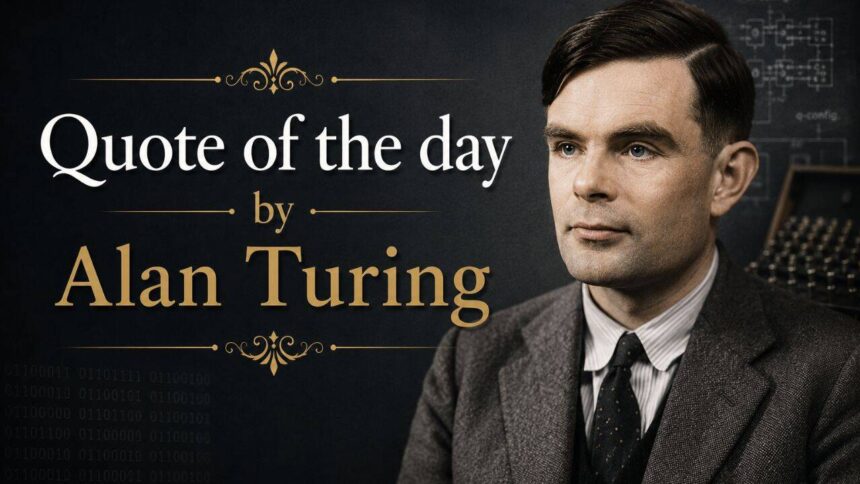
The advent of artificial intelligence has led to a new era in human history, where machines are increasingly capable of holding conversations, learning, and even outperforming humans in various tasks. However, as the conversation around AI continues to evolve, one question remains at the forefront: what happens when a machine is able to think more intelligently than we do? This is the question posed by the legendary mathematician and computer scientist Alan Turing in the early 20th century, and one that still resonates today.
From Enigma to Ethics: Turing’s Vision for AI
Turing, a British mathematician and logician, is best known for cracking the German Enigma code during World War II, a feat that played a significant role in the Allied victory. However, his work went beyond cryptography and computer science. He was a pioneer in the field of artificial intelligence, and his 1950 paper, ‘Computing Machinery and Intelligence,’ proposed a test to determine whether a machine could think like a human. The Turing Test, as it came to be known, is still used today to evaluate the ability of machines to exhibit intelligent behavior equivalent to, or indistinguishable from, that of a human.
Turing’s question, ‘If a machine can think, it might think more intelligently than we do, and then where should we be?’ was a precursor to the ongoing debate about the ethics of AI. He foresaw the potential for machines to surpass human intelligence, and the implications that would have on society. This concern is still relevant today, as AI systems are increasingly integrated into our daily lives, from virtual assistants to self-driving cars.
The Turing Test: A Measure of Intelligence or a Social Construct?
The Turing Test has been used to evaluate the performance of AI systems, but its limitations have also been widely debated. The test relies on a simple question-and-answer format, where a human evaluator engages in conversation with a machine, without knowing whether they are interacting with a human or a computer. However, this approach has been criticized for its narrow focus on language and its inability to capture the full range of human intelligence.
Moreover, the Turing Test has been accused of being too simplistic, as it fails to account for the complexities of human behavior and cognition. AI systems can excel in specific tasks, such as playing chess or recognizing images, but they lack the nuance and creativity that is inherent in human intelligence.
Where Should We Be? The Future of AI and Human Intelligence
Turing’s question remains a pressing concern in the age of AI. As machines continue to improve their performance and capabilities, we are faced with the prospect of a future where AI surpasses human intelligence. This raises fundamental questions about the nature of intelligence, the role of humans in a world dominated by machines, and the ethics of creating and using AI.
The future of AI is likely to be shaped by a combination of technological advancements, societal needs, and moral considerations. As we continue to develop and integrate AI into our lives, we must also address the implications of a world where machines are more intelligent than humans. This requires a nuanced and multidisciplinary approach, one that takes into account the complexities of human intelligence and the potential consequences of creating intelligent machines.
Turing’s question remains a powerful reminder of the need for caution and reflection in the development and use of AI. As we navigate the complexities of this new era, we must continue to ask ourselves, ‘If a machine can think, it might think more intelligently than we do, and then where should we be?’