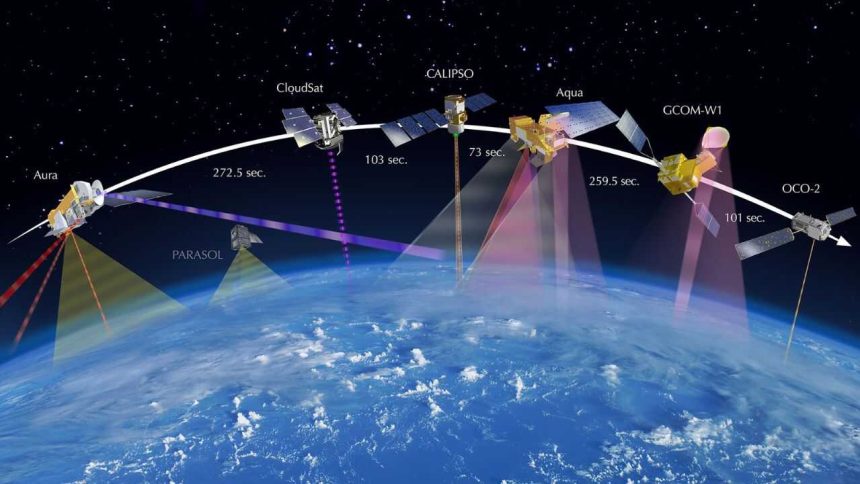
The night sky, once a celestial canvas of twinkling stars and celestial wonders, is on the cusp of a profound transformation. As the world hurtles towards a new era of space exploration and technological advancement, a silent yet insidious threat is emerging: the sheer scale of artificial satellite constellations. With over 1.7 million planned satellites set to occupy the skies above, astronomers and scientists are sounding the alarm on a potential new form of space pollution, one that could forever alter the appearance and accessibility of the night sky.
Light Pollution 2.0: The Rise of Orbital Traffic
The notion of light pollution has long been a concern for astronomers, who have worked tirelessly to mitigate its effects on their observations. However, the advent of large-scale telecommunication networks, such as SpaceX’s Starlink, has introduced a new and formidable challenge to the field. These satellite constellations, comprising hundreds of thousands of individual satellites, are transforming the orbital landscape and creating a new form of pollution that threatens to eclipse the light pollution of the past.
While light pollution emanates from Earth, the new form of pollution is a direct result of the increasing number of satellites in orbit. As the world’s telecommunications companies continue to launch new constellations, the cumulative effect of their collective radiation is beginning to take its toll on the night sky. The problem is not limited to the sheer number of satellites, but also the fact that they are being deployed in such high numbers, often without adequate consideration for their impact on the celestial environment.
Astronomical Access and the Future of Space Exploration
The implications of this new form of pollution extend far beyond the realm of aesthetics, however. As the number of satellites in orbit continues to grow, astronomers are facing a daunting challenge in their ability to access and study the night sky. With hundreds of thousands of satellites competing for visibility, the task of distinguishing between celestial objects and man-made infrastructure is becoming increasingly difficult.
The consequences of this are far-reaching, with the potential to impact a wide range of scientific disciplines, from astronomy and astrophysics to planetary science and astrobiology. As the world’s leading scientists and researchers work to unravel the mysteries of the universe, they are being forced to confront the very real possibility that their ability to study the night sky may be severely compromised.
The Path Forward: Mitigating the Impact of Satellite Constellations
While the situation may seem dire, there is hope on the horizon. Scientists and policymakers are beginning to engage in a critical debate about the need for greater regulation and oversight of the satellite industry. By implementing more stringent guidelines and standards, it may be possible to mitigate the impact of satellite constellations and preserve the night sky for generations to come.
Ultimately, the fate of the night sky hangs in the balance. As the world continues to push the boundaries of space exploration and technological advancement, it is imperative that we prioritize the preservation of our celestial heritage. By working together to address the challenges posed by satellite constellations, we can ensure that the night sky remains a source of wonder and inspiration for future generations.