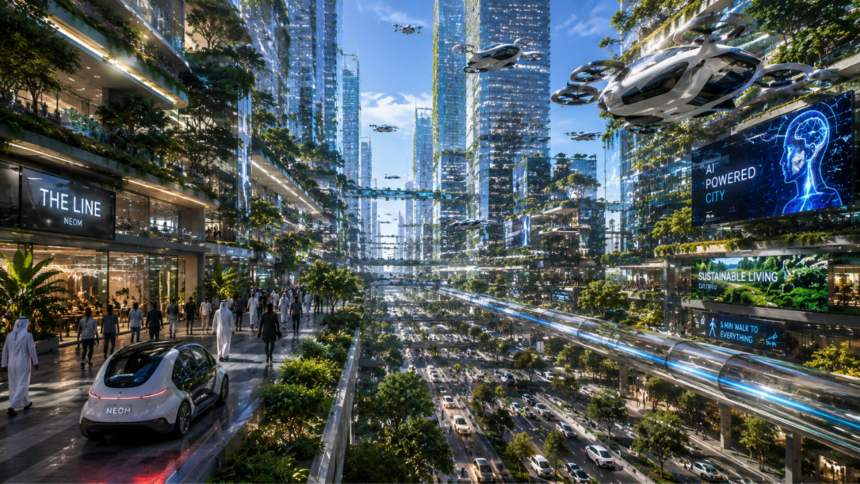
Saudi Arabia’s ambitious plan to build a $9 trillion futuristic city, dubbed NEOM, has been significantly scaled back, leaving many to wonder what went wrong. When Crown Prince Mohammed bin Salman unveiled the project in 2017, it promised to be a marvel of modern technology, featuring flying taxis, a 170-kilometer-long skyscraper, and a host of other innovative features. The mega-project was envisioned as the centrepiece of the kingdom’s Vision 2030 strategy to reduce dependence on oil and diversify the economy. However, after years of hype and anticipation, the project’s scope and timeline have been drastically revised, sparking concerns about the future of this futuristic dream city.
Revisiting the Vision
NEOM was initially conceived as a 26,500-square-kilometer metropolis, powered entirely by renewable energy, with a projected population of one million inhabitants. The city was designed to be a hub for cutting-edge industries, including robotics, artificial intelligence, and biotechnology. The project’s architects and engineers had envisioned a futuristic urban landscape, with towering skyscrapers, advanced public transportation systems, and state-of-the-art infrastructure. However, as the project progressed, it became clear that the initial vision was overly ambitious, and the timeline for completion was unrealistic.
The scaling back of NEOM has been attributed to a combination of factors, including logistical challenges, financing issues, and geopolitical tensions. The project’s location in the northwestern region of Saudi Arabia, near the Jordanian border, has also posed significant infrastructure and transportation challenges. Furthermore, the kingdom’s economic woes, including a decline in oil prices and a slowdown in economic growth, have forced the government to reassess its priorities and allocate resources more efficiently.
Assessing the Impact
The revision of NEOM’s plans has significant implications for Saudi Arabia’s economic and social development. The project was seen as a key driver of the kingdom’s diversification efforts, aimed at reducing dependence on oil exports and promoting private sector growth. While the scaled-back version of NEOM is still expected to create jobs and stimulate economic activity, it is unlikely to have the same transformative impact as initially envisioned. The project’s failure to deliver on its promise has also raised questions about the kingdom’s ability to execute large-scale development projects and attract foreign investment.
The scaling back of NEOM has also sparked concerns about the fate of other mega-projects in Saudi Arabia, including the Red Sea tourism project and the Qiddiya entertainment city. These projects, like NEOM, were designed to promote economic diversification and attract foreign investment. However, they also face significant challenges, including logistical and financing issues, which could impact their viability and success. As the kingdom continues to navigate the complexities of economic development, it must balance its ambition with realism and ensure that its projects are aligned with its economic and social priorities.
Looking Ahead
Despite the setbacks, Saudi Arabia remains committed to the development of NEOM, albeit in a more scaled-back and realistic form. The kingdom has announced plans to establish a new company to oversee the project’s development, with a focus on creating a special economic zone that can attract foreign investment and promote private sector growth. The project’s revised timeline and scope are still unclear, but it is expected to be completed in phases, with the first phase focusing on the development of essential infrastructure and utilities.
As Saudi Arabia moves forward with the development of NEOM, it must learn from the mistakes of the past and adopt a more pragmatic and realistic approach. This includes engaging with local communities, addressing logistical and financing challenges, and ensuring that the project is aligned with the kingdom’s economic and social priorities. By doing so, the kingdom can ensure that NEOM becomes a successful and sustainable project that contributes to the country’s long-term growth and development.
The story of NEOM serves as a reminder that even the most ambitious and well-funded projects can face significant challenges and setbacks. However, with perseverance, adaptability, and a commitment to learning from mistakes, it is possible to turn vision into reality and create a better future for generations to come. As the kingdom continues to navigate the complexities of economic development, one thing is clear: the fate of NEOM will have a significant impact on the future of Saudi Arabia and its people.