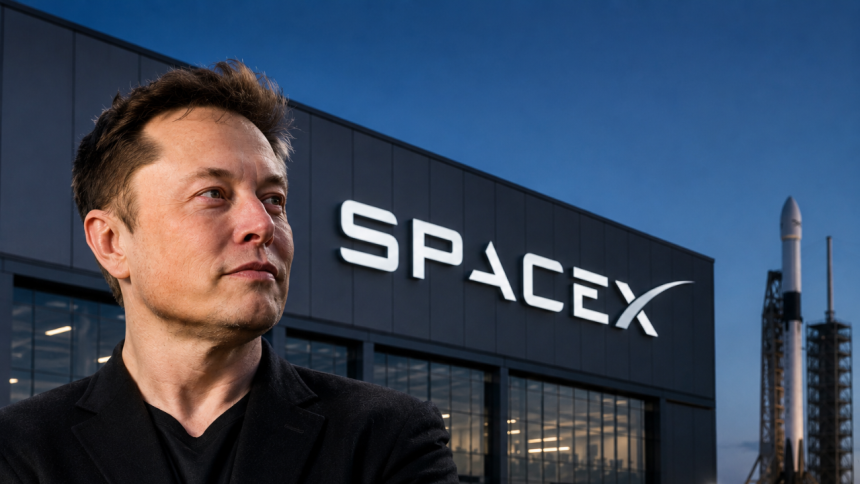
As the countdown begins for SpaceX’s highly anticipated initial public offering (IPO), the Elon Musk-led company is poised to make history by becoming one of the largest publicly traded entities in the world. The rocket ship manufacturer and space exploration pioneer is seeking to raise a staggering $75 billion at a valuation of approximately $1.75 trillion, a figure that would catapult it into the echelons of the world’s most valuable companies from the very start. This monumental offering has sent ripples through the financial markets, with many experts hailing it as a watershed moment in the space industry.
Listing Date, Valuation, and More: Key Details to Know
The IPO is expected to list on the New York Stock Exchange (NYSE) under the ticker symbol ‘SPACE.’ The exact listing date has not been officially announced, but sources close to the company indicate that it will take place sometime this week. As for the valuation, it’s a staggering $1.75 trillion, which would make SpaceX one of the largest and most valuable companies in the world, dwarfing even the likes of Amazon and Alphabet. The company’s market capitalization would be roughly 10 times that of its nearest rival, the aerospace and defense contractor Boeing.
Despite the massive valuation, SpaceX’s IPO is not without its challenges. The company is expected to face intense scrutiny from investors, analysts, and regulators, who will be keenly watching its revenue growth, profitability, and competitiveness in the space industry. Additionally, Musk’s reputation and leadership style have raised concerns among some investors, who worry that his mercurial nature and tendency to take bold risks might not align with the stability and predictability that investors typically seek.
SpaceX’s Business Model and Financial Projections
SpaceX’s business model is built around a mix of government contracts, commercial satellite launches, and its ambitious Starlink internet constellation program. The company has already secured several major government contracts, including a $2.9 billion deal with NASA to develop a new lunar lander. Additionally, SpaceX’s Starlink program is expected to generate significant revenue from satellite internet subscriptions, with the company projecting $30 billion in annual revenue by 2025.
However, despite these promising prospects, SpaceX’s financial projections have raised eyebrows among some analysts. The company’s projected revenue growth is impressive, but its profit margins are expected to be slim, with some estimates suggesting that net income will be a mere 5% of revenue. This has led some to question whether SpaceX’s valuation is sustainable, especially considering the intense competition in the space industry and the risk of regulatory hurdles.
Regulatory Landscape and Competitive Advantage
SpaceX’s regulatory landscape is complex and fraught with risk. The company faces stiff competition from established players like Boeing, Lockheed Martin, and Blue Origin, as well as new entrants like Virgin Galactic. Additionally, regulatory hurdles, such as obtaining licenses for commercial satellite launches and navigating the complexities of space debris management, pose significant challenges for the company.
Despite these challenges, SpaceX’s competitive advantage lies in its innovative technology and Musk’s vision for a human settlement on Mars. The company’s reusable rockets have disrupted the space industry, making satellite launches more affordable and efficient. Additionally, its Starlink program has the potential to revolutionize internet access, especially in remote and underserved areas.
As SpaceX’s IPO looms on the horizon, investors and analysts will be closely watching the company’s financial performance, competitive position, and regulatory landscape. While there are risks and challenges ahead, the potential rewards are substantial, and many believe that SpaceX’s pioneering spirit and innovative technology make it an attractive investment opportunity.
SpaceX’s IPO may mark a new era in the space industry, with the company’s valuation and market capitalization setting a new benchmark for the sector. Whether it will live up to the hype remains to be seen, but one thing is certain: SpaceX’s journey into the public markets will be a wild ride that will captivate investors, analysts, and space enthusiasts alike.