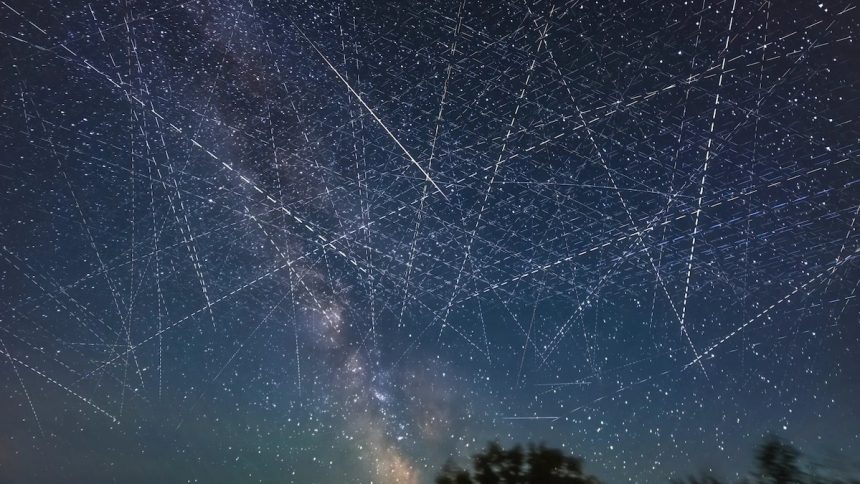
The night sky, once a canvas of twinkling stars and celestial wonder, is slowly being transformed into a crowded highway of satellites. As we gaze up at the darkness, we’re no longer alone – thousands of artificial companions are crawling across the horizon, leaving trails of light in their wake. The sheer scale of this phenomenon is staggering, with over 10,000 satellites currently orbiting the Earth, and many more on the way. This raises a pressing question: what will happen to our night skies when a million satellites are launched into orbit?
The Impact on Astronomy
The effects of satellite constellations on astronomy are already being felt. Professional astronomers are struggling to collect data without the interference of satellite trails, which can ruin hours of observation in a matter of seconds. The problem is not just limited to professional observatories – amateur stargazers and astrophotographers are also finding it increasingly difficult to capture the night sky without the unwanted presence of satellites. As the number of satellites grows, so does the risk of permanent damage to our ability to study the universe. The long-term consequences of this are difficult to predict, but one thing is certain – the night sky will never be the same again.
The issue is not just about aesthetics; it’s also about the scientific implications of having a crowded night sky. Astronomers rely on dark skies to make new discoveries and push the boundaries of human knowledge. With satellites interfering with observations, we may be missing out on crucial information about the universe and its many mysteries. The night sky is a window into the cosmos, and if we can’t see through it clearly, we risk losing our understanding of the world around us.
The Regulatory Environment
The launch of satellite constellations has sparked a heated debate about regulation and the need for international cooperation. Currently, there are no clear guidelines or laws governing the deployment of satellites in orbit. This lack of oversight has created a free-for-all environment, where companies can launch satellites without considering the long-term consequences of their actions. As the number of satellites grows, so does the risk of collisions, space debris, and other hazards. The need for regulation is clear, but the question is – who will take the lead and establish the necessary guidelines to protect our night skies?
The regulatory environment is complex, with multiple stakeholders and interests at play. Governments, companies, and international organizations all have a role to play in shaping the future of satellite deployments. However, the lack of clarity and coordination is hindering efforts to address the issue. As the situation continues to escalate, it’s becoming increasingly urgent to establish a framework for responsible satellite launches and operations. The night sky is a global treasure, and it’s up to us to protect it for future generations.
A New Era for Space Exploration
The launch of satellite constellations marks a new era for space exploration, one that’s driven by commercial interests and technological advancements. As we continue to push the boundaries of what’s possible in space, we must also consider the ethical implications of our actions. The night sky is not just a resource for scientists and astronomers; it’s also a source of inspiration and wonder for people around the world. As we embark on this new era of space exploration, we must prioritize the protection of our planet and its natural resources, including the night sky.
The future of space exploration is full of possibilities, from colonizing other planets to harnessing the power of the sun. However, as we reach for the stars, we must not forget the beauty and importance of our own planet. The night sky is a reminder of our place in the universe and the fragility of our existence. As we continue to explore and push the boundaries of what’s possible, we must do so with responsibility and respect for the world around us. The night sky is a treasure that’s worth fighting for, and it’s up to us to ensure its protection for generations to come.
The clock is ticking, and the fate of our night skies hangs in the balance. As we stand at the threshold of this new era, we must choose between progress and preservation. The decision we make will have far-reaching consequences, not just for astronomy and science, but for our collective understanding of the universe and our place within it. The night sky is a priceless resource, and it’s up to us to protect it for the future. We owe it to ourselves, our children, and the generations that will come after us to preserve the beauty and wonder of the night sky, and to ensure that it remains a source of inspiration and awe for years to come.