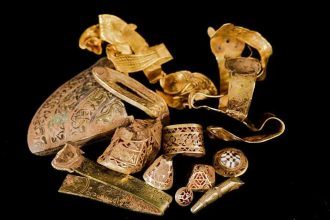
The year 2015 marked a significant turning point in the study of English history, as the discovery of the Watlington Hoard in Oxfordshire shed new light on the reign of the legendary King Alfred the Great. A few silver coins, unearthed in a field, revealed an intriguing story of an unlikely alliance between the West Saxon king and Ceolwulf II, the ruler of Mercia, a powerful Anglo-Saxon kingdom. The hoard, comprising 129 coins and other artifacts, rewrote the narrative of a tumultuous era in Anglo-Saxon history, challenging long-held assumptions about the relationships between rival kingdoms.
A New Perspective on King Alfred the Great
The Watlington Hoard, dated to the 9th century, is a treasure trove of information about the complex web of alliances and rivalries that defined Anglo-Saxon England. Among the coins, some bear the image of King Alfred the Great, while others display the emblem of Ceolwulf II. This suggests that the two rulers collaborated on a significant scale, potentially even sharing power or resources in the face of Viking invasions. The implications of this alliance are profound, as it challenges the prevailing view of King Alfred as a solitary figure, fighting against overwhelming odds to defend his kingdom.
The discovery has sparked debate among historians, with some hailing it as a major breakthrough in our understanding of Anglo-Saxon England. The hoard’s significance extends beyond the realm of history, as it highlights the importance of cooperation and diplomacy in times of conflict. King Alfred’s reputation as a wise and just ruler may have been augmented by his willingness to form alliances, illustrating the value of strategic partnerships in the pursuit of peace and stability.
The Significance of the Watlington Hoard
The Watlington Hoard is more than just a collection of coins; it is a window into the past, offering a glimpse into the lives of people who lived during one of the most turbulent periods in English history. The coins, minted with the images of King Alfred and Ceolwulf II, are a testament to the power and influence of these two rulers. The hoard’s contents also provide valuable insights into the economic and social dynamics of the time, revealing a complex network of trade and exchange between rival kingdoms.
The study of the Watlington Hoard has far-reaching implications for historians and archaeologists, as it opens up new avenues of research and inquiry. By re-examining the relationships between Anglo-Saxon kingdoms, scholars can gain a deeper understanding of the social, cultural, and economic forces that shaped the development of England. The discovery serves as a reminder of the importance of interdisciplinary approaches, combining history, archaeology, and numismatics to reconstruct the past.
The Legacy of the Watlington Hoard
The Watlington Hoard has left an indelible mark on our understanding of Anglo-Saxon England, challenging long-held assumptions and revealing a more nuanced picture of the past. As historians continue to study the hoard, they are uncovering a rich tapestry of stories, alliances, and rivalries that defined an era of great turmoil and transformation. The legacy of the Watlington Hoard serves as a powerful reminder of the importance of cooperation, diplomacy, and strategic partnerships in achieving peace and stability, even in the most trying of times.
The discovery of the Watlington Hoard has reignited interest in the study of Anglo-Saxon England, inspiring a new generation of historians and archaeologists to explore the complexities of the past. As we continue to unravel the mysteries of the hoard, we are reminded of the significance of the past in shaping our present and our future.