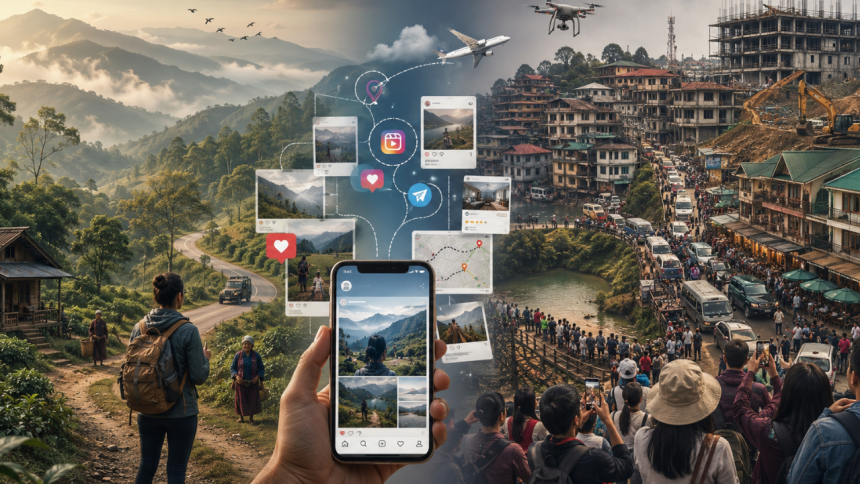
The thrill of the unknown has long been a driving force behind travel. For generations, families huddled around maps, poring over guidebooks, and scouring the web for hidden gems. But in an era of social media and Instagram influencers, the allure of the offbeat is being slowly eroded. Once-treasured secrets are now splashed across feeds, beckoning the masses to follow in their footsteps. As the travel landscape evolves, what happens when offbeat destinations go mainstream?
Unraveling the Threads of Authenticity
For many, the draw of the unknown lies in the unspoiled. Places where the air is fresh, the landscapes untainted, and the locals untouched by the trappings of modernity. Take the small town of Tana Toraja in Indonesia, where elaborate funeral rituals have long been a testament to the community’s unyielding respect for tradition. The town’s remote location and limited accessibility once shielded it from the influx of tourists. However, the rise of Instagram has led to an influx of visitors, threatening to disrupt the delicate balance between culture and commerce.
Local residents, once content with their quiet lives, are now faced with the challenge of adapting to the demands of mass tourism. The streets, once lined with verdant rice fields, are now dotted with souvenir shops and restaurants catering to the tastes of outsiders. The authentic, unbridled spirit of Tana Toraja’s people is slowly giving way to the pressures of commercialization. The question remains: at what cost do we pay for the privilege of experiencing the exotic?
The Economic Double-Edged Sword
The economic benefits of tourism are undeniable. Local economies are infused with a new influx of cash, creating jobs and stimulating growth. However, the strain on infrastructure and resources soon becomes apparent. Overcrowding, pollution, and the degradation of natural habitats are just a few of the consequences of unchecked tourism. In the Maldives, a nation of islands renowned for its crystal-clear waters and pristine beaches, the effects of over-visitation are already manifest.
The construction of luxury resorts and hotels has transformed once-pristine landscapes into crowded, concrete jungles. The noise, pollution, and strain on resources have taken a devastating toll on the environment. As the demand for exclusive getaways continues to rise, the Maldives faces a daunting challenge: can it balance the needs of its economy with the imperative of preserving its unique natural heritage?
The Search for the Authentic Experience
In the face of mainstream tourism, travelers are increasingly seeking out alternative destinations, off the beaten path and free from the trappings of commercialization. Hidden coves, secluded beaches, and rustic villages are now the holy grail of travel. But as the search for authenticity intensifies, a new breed of traveler is emerging: the ‘slow traveler.’
This is a traveler who eschews the crowds and the noise, opting instead for a more immersive, experiential approach to travel. They seek out local communities, participate in traditional activities, and take the time to truly absorb the culture. The slow traveler is a harbinger of a new era in travel, one that values depth over breadth, and meaning over mere sightseeing.
As the world grapples with the consequences of mainstream tourism, there is hope on the horizon. Travelers are beginning to recognize the value of preserving the very essence of the destinations they visit. By embracing the slow, experiential approach, we can ensure that the offbeat remains offbeat, and the allure of the unknown remains intact.