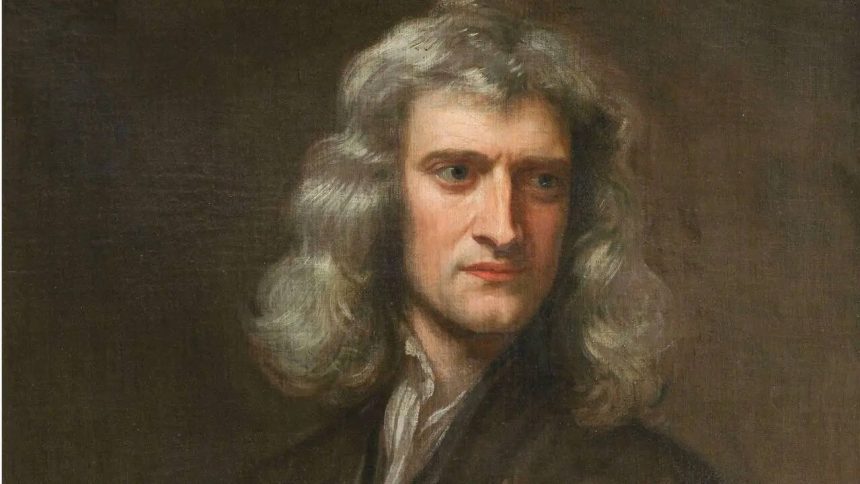
In the realm of science and philosophy, few questions have been as enduringly relevant as the search for truth. For centuries, humanity has grappled with the challenge of distinguishing fact from fiction, and the weight of uncertainty has hung heavy over our understanding of the world. Isaac Newton, one of the most influential minds in history, dedicated a significant portion of his life to addressing this very question, leaving behind a legacy that continues to shape our pursuit of knowledge today.
The Problem of Perception
Newton’s most famous anecdote, the story of an apple falling from a tree, has become synonymous with his work on gravity. Yet, historians continue to debate the accuracy of this tale, suggesting that it may have been embellished or even fabricated. This raises an interesting question: can we truly trust our perceptions of reality? Newton’s work on optics and the nature of light further complicates this issue, highlighting the limitations of our senses in accurately perceiving the world around us. Through his research, Newton demonstrated that our understanding of the world is filtered through a complex web of assumptions, biases, and cognitive distortions, which can lead us to misinterpret or even fabricate facts.
One of the most striking examples of this phenomenon is Newton’s own work on the behavior of white light. By passing light through a prism, Newton discovered that it is composed of a spectrum of colors, which can be separated and recombined at will. This discovery challenged the prevailing understanding of the time, which held that white light was a single entity. Newton’s findings, however, revealed a more nuanced and complex reality, one that was shaped by the very tools and techniques used to observe it. This experience serves as a powerful reminder that our perceptions of reality are always mediated by the instruments and frameworks we use to study the world.
The Challenge of Verification
So, how do we verify the truth of our perceptions and avoid falling prey to cognitive distortions and biases? Newton’s work on the nature of scientific inquiry provides a valuable insight into this challenge. He recognized that the pursuit of truth requires a rigorous and systematic approach, one that involves the use of empirical evidence, mathematical proof, and peer review. By subjecting our findings to the scrutiny of others, we can increase the reliability of our conclusions and reduce the risk of error.
However, this approach is not foolproof. Newton’s own experiences demonstrate that even the most well-established theories can be overturned by new evidence or alternative perspectives. The history of science is replete with examples of paradigm-shifting discoveries that challenged our existing understanding of the world. Newton’s work on gravity, for instance, was eventually superseded by Albert Einstein’s theory of general relativity, which provided a more comprehensive and accurate description of the natural world.
The Enduring Legacy of Newton’s Quest
Isaac Newton’s pursuit of truth and his quest to understand the nature of reality have had a profound impact on the development of modern science. His work on optics, light, and gravity laid the foundations for some of the most significant advances in our understanding of the universe, from the behavior of particles at the quantum level to the expansion of the cosmos itself. But Newton’s legacy extends beyond his scientific achievements. His commitment to the pursuit of truth and his recognition of the limitations of human perception serve as a powerful reminder of the importance of humility and critical thinking in our pursuit of knowledge.
As we continue to grapple with the complexities of the modern world, Newton’s quest for truth remains a vital and relevant challenge. By embracing his legacy and continuing to question our assumptions and perceptions, we can ensure that our pursuit of knowledge remains grounded in a deep respect for the complexity and nuance of the world around us.