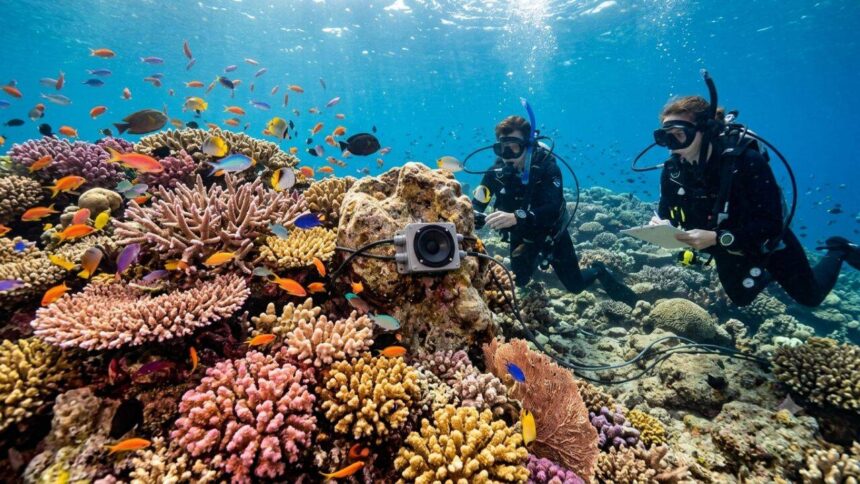
The decline of coral reefs has long been a topic of concern, with rising sea temperatures and fading marine life often cited as the primary causes. However, a lesser-known aspect of this decline is the disappearance of sound from these underwater ecosystems. Scientists have recently made a groundbreaking discovery that suggests the sounds of a healthy reef can have a profound impact on the health and vitality of the coral itself. By playing recordings of a thriving reef in an area where the coral had become dormant, researchers were able to stimulate the growth of new coral and revitalize the surrounding ecosystem.
The Power of Sound
Researchers have long known that coral reefs are not just visually stunning, but also produce a wide range of sounds, from the clicks and whistles of dolphins to the snapping of shrimp. These sounds play a crucial role in the communication and behavior of the many species that call the reef home. By recording and playing back these sounds, scientists hoped to stimulate the coral and encourage it to regrow. The results were nothing short of astonishing, with the coral beginning to show signs of new growth and the surrounding ecosystem starting to flourish once again.
The implications of this discovery are far-reaching, and could potentially be used to restore damaged or dying reefs around the world. The technique is relatively simple and inexpensive, making it a viable option for conservation efforts. As the world continues to grapple with the challenges of climate change and environmental degradation, this breakthrough offers a glimmer of hope for the long-term health of our planet’s coral reefs.
The Science Behind the Discovery
The team of researchers behind the discovery used a combination of underwater recordings and specialized equipment to play back the sounds of a healthy reef. The recordings were taken from a thriving reef in the same region, and featured a wide range of sounds, from the calls of fish to the rustling of seaweed. The equipment used to play back the recordings was specially designed to mimic the natural sounds of the reef, and was placed in the area where the coral had become dormant.
The results of the experiment were carefully monitored, with researchers tracking the growth of new coral and the activity of the surrounding ecosystem. The data collected during the experiment will be used to further refine the technique, and to explore its potential for use in other damaged or dying reefs. As the study continues, scientists are eager to learn more about the complex relationships between sound, coral, and the surrounding ecosystem.
A New Era for Coral Reef Conservation
The discovery that playing recordings of a healthy reef can stimulate the growth of new coral has the potential to revolutionize the field of coral reef conservation. For years, scientists have been searching for effective ways to restore damaged or dying reefs, and this breakthrough offers a new and promising approach. The technique is not only relatively simple and inexpensive, but also non-invasive, making it a viable option for use in sensitive or protected areas.
As news of the discovery spreads, conservationists and scientists around the world are taking notice. The potential for this technique to be used in conjunction with other conservation efforts is vast, and could potentially be used to restore reefs that have been damaged by pollution, overfishing, or climate change. While there is still much to be learned about the complex relationships between sound, coral, and the surrounding ecosystem, this breakthrough offers a glimmer of hope for the long-term health of our planet’s coral reefs. The sound of revival is a welcome one, and scientists are eager to continue exploring the potential of this innovative approach to conservation.