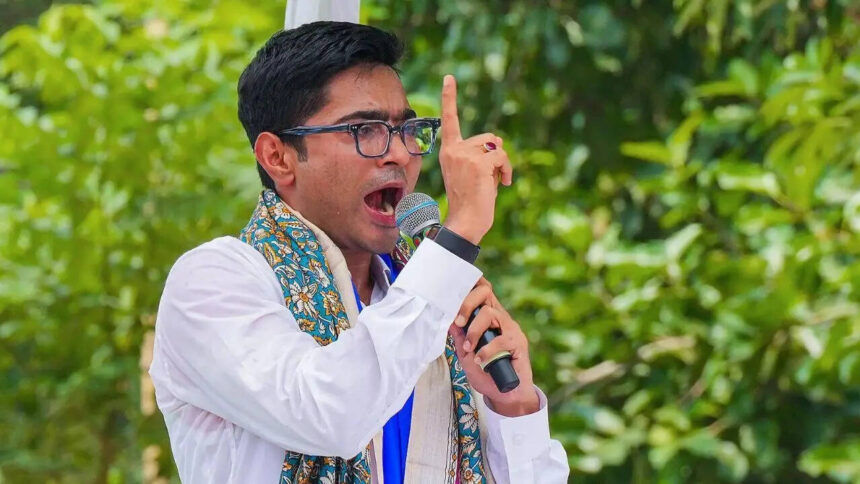
The Lok Sabha, India’s lower house of parliament, is bracing for a contentious battle as Trinamool Congress Parliamentary Party leader Abhishek Banerjee writes to Speaker Om Birla, urging him not to recognize a rebel TMC bloc. The move marks a critical moment in the party’s internal struggle, pitting Banerjee against a faction of MLAs who have been vocal about their discontent with the party leadership.
The letter, which cites legal and Constitutional provisions, makes it clear that Banerjee sees no room for compromise or recognition of the rebel group. The party’s position, he argues, must be treated as a single, unified entity represented in the House, with no scope for factional divisions or separate representation. This stance is expected to be met with resistance from the rebel MLAs, who claim that Banerjee’s leadership has become increasingly autocratic and out of touch with the party’s grassroots.
The crisis within the Trinamool Congress has been simmering for months, with several MLAs openly questioning Banerjee’s leadership style and decision-making. The party’s performance in the recent Assembly polls in West Bengal, where the TMC suffered a significant decline in seats, has further exacerbated tensions. Banerjee’s letter to Speaker Birla is seen as a bid to assert his authority and maintain party unity, even as the rebel MLAs threaten to break ranks and challenge his leadership.
The Party’s History and the Current Power Struggle
The Trinamool Congress, founded by Mamata Banerjee in 1998, has evolved into one of India’s most prominent regional parties. Under Mamata’s leadership, the party came to power in West Bengal in 2011, ending decades of Left Front rule. Abhishek Banerjee, Mamata’s nephew, rose to prominence within the party and became the General Secretary in 2018. However, his rapid ascent has been accompanied by growing resentment among some party members, who feel that he is becoming increasingly distant from the party’s core values and grassroots.
The current power struggle within the TMC is a complex web of personal and ideological differences. While Banerjee’s supporters see him as a modernizer and a skilled administrator, his critics view him as a power-hungry leader who is willing to do whatever it takes to maintain his grip on the party. The rebel MLAs, who claim to represent the party’s ‘true’ interests, have been vocal about their opposition to Banerjee’s leadership and his decision-making style.
The Lok Sabha Speaker’s response to Banerjee’s letter will be closely watched, as it has the potential to either exacerbate or mitigate the crisis within the Trinamool Congress. If Speaker Birla recognizes the rebel TMC bloc, it could create a constitutional crisis, with potentially far-reaching implications for the party and the Indian polity.
The Constitutional Framework and the Speaker’s Role
The Indian Constitution grants the Lok Sabha Speaker significant powers, including the authority to recognize and admit members to the House. In the event of a dispute, the Speaker’s decision is final and binding. However, the Speaker is also required to act in accordance with the Constitution and the rules of the House.
Banerjee’s letter to Speaker Birla makes a strong case for the Speaker to reject the rebel TMC bloc, citing the party’s history, its Constitution, and the rules of the House. He argues that the party must be treated as a single, unified entity, with no scope for factional divisions or separate representation. The Speaker’s response will depend on a careful analysis of the party’s internal dynamics and the constitutional framework governing the Lok Sabha.
The outcome of this crisis will have significant implications for the Trinamool Congress, the Lok Sabha, and the Indian polity as a whole. As the battle for party unity rages on, one thing is clear: the TMC’s future hangs in the balance, and the Lok Sabha Speaker’s decision will be a crucial factor in determining the party’s destiny.
The Future of the Trinamool Congress
The crisis within the Trinamool Congress has the potential to reshape the party’s future, potentially even altering its trajectory. Banerjee’s leadership has been the subject of intense scrutiny, with many questioning his ability to lead the party to electoral success. The rebel MLAs, who claim to represent the party’s ‘true’ interests, have been vocal about their opposition to Banerjee’s leadership and his decision-making style.
The outcome of this crisis will depend on a range of factors, including the Speaker’s response to Banerjee’s letter, the party’s internal dynamics, and the response of the Lok Sabha membership. One thing is certain: the Trinamool Congress will emerge from this crisis transformed, with a new leadership paradigm and a redefined role in Indian politics.
The Lok Sabha Speaker’s decision will be a critical moment in the party’s history, marking a turning point in its trajectory. Will Banerjee’s leadership prevail, or will the rebel MLAs break ranks and challenge his authority? The outcome of this crisis will have far-reaching implications for the Trinamool Congress, the Lok Sabha, and the Indian polity as a whole.