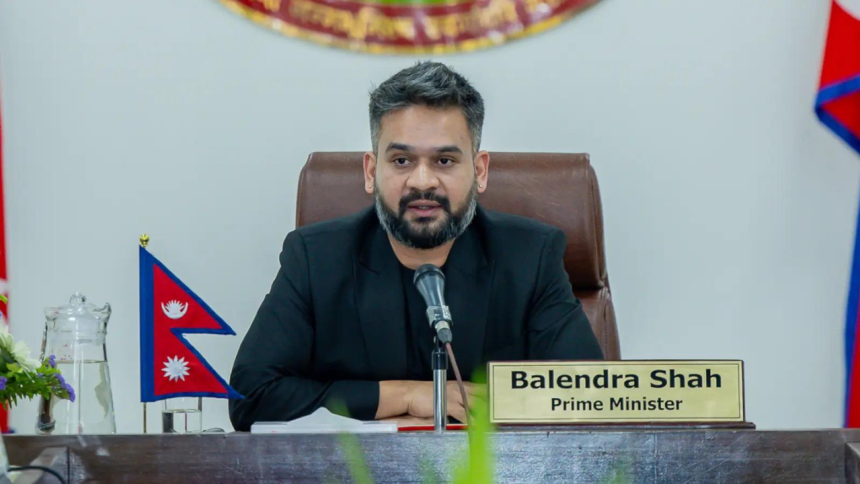
Nepal’s Prime Minister Balendra Shah stepped up diplomatic efforts last Sunday by calling for dialogue with India to resolve long-standing border issues, while proposing that the UK play a crucial role in facilitating the talks. The Prime Minister’s statement underscores the complex history of border disputes between these two South Asian nations and highlights the need for a collaborative approach to address the issues.
The border dispute between Nepal and India has been a longstanding issue, with both countries claiming sovereignty over certain territories. In recent years, tensions have escalated over issues such as the construction of a new road in the Lipulekh region and the distribution of water resources. The dispute has not only strained bilateral relations but also affected the livelihoods of local communities.
Prime Minister Balendra Shah’s proposal to involve the UK in the talks is based on the historical context of the border demarcation. During the colonial era, the British Empire played a significant role in shaping the modern borders of the region. Shah’s argument is that a third-party facilitator, such as the UK, could provide a neutral perspective and help the two nations find a mutually acceptable solution.
History of Border Disputes
The border dispute between Nepal and India dates back to the 19th century when the British Empire imposed its own borders on the region. The border was demarcated based on the British interests, rather than the geographical and cultural characteristics of the region. This led to several disputes over the years, with both countries claiming sovereignty over certain territories.
The dispute became more pronounced in the 20th century, particularly after India gained independence from British rule in 1947. Nepal, which had been a British protectorate, became an independent nation, but the border dispute remained unresolved. In recent years, the dispute has taken on a new dimension, with both countries competing for economic and strategic interests.
Nepal’s Diplomatic Efforts
Prime Minister Balendra Shah’s proposal to involve the UK in the talks is part of a broader diplomatic effort by Nepal to resolve the border dispute. In recent months, Nepal has engaged in several rounds of talks with India, but the process has been slow and inconclusive. Shah’s proposal is seen as a creative attempt to break the deadlock and find a solution through dialogue.
Nepal’s diplomatic efforts have been driven by a desire to strengthen its sovereignty and protect its territorial integrity. The country has been working closely with international organizations, such as the United Nations, to seek support for its claims and to promote a peaceful resolution to the dispute.
Challenges Ahead
The Nepal-India border dispute is a complex issue that requires a nuanced approach. Both countries have competing interests and historical claims, which need to be addressed through a collaborative and inclusive process. Prime Minister Balendra Shah’s proposal to involve the UK in the talks is a step in the right direction, but it remains to be seen whether this initiative will succeed in resolving the dispute.
The success of the diplomatic efforts will depend on the willingness of both countries to engage in constructive dialogue and to compromise on their positions. The involvement of the UK could provide a much-needed boost to the talks, but it is also essential for both countries to demonstrate a genuine commitment to finding a peaceful solution.
The Nepal-India border dispute is a test case for the region’s ability to resolve complex territorial disputes through diplomacy. If the two countries can find a mutually acceptable solution, it will not only strengthen their bilateral relations but also set a positive precedent for other countries in the region.
Prime Minister Balendra Shah’s call for dialogue and the UK’s involvement in the talks offers a glimmer of hope for a resolution to this long-standing dispute. The success of this initiative will depend on the ability of both countries to work together and find a solution that takes into account the historical, cultural, and geographical context of the region.