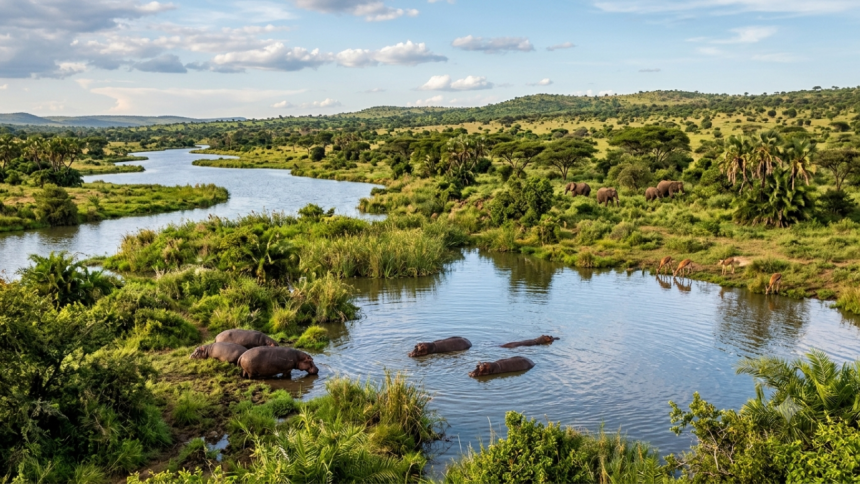
The Sahara Desert has long been perceived as a harsh and unforgiving environment, a seemingly endless expanse of sand and rock that stretches across North Africa. Yet, beneath its surface, lies a story of transformation and rebirth. Geologists have revealed that the Sahara was once a lush and vibrant landscape, home to rivers, giant lakes, and even hippos. The notion that this unforgiving desert was once teeming with life challenges our understanding of the region’s evolution and raises questions about the forces that have shaped its history.
Unearthing the Sahara’s Forgotten Past
Scientists have pieced together a narrative of the Sahara’s past through the analysis of fossil records, geological samples, and satellite imagery. They have discovered that the region was once home to a network of rivers, which flowed through the Sahara and supported a diverse array of flora and fauna. The rivers, which were likely fed by a combination of rainfall and meltwater from glaciers, created a series of giant lakes, some of which were as large as the Great Lakes in North America. The lakes, in turn, supported a wide range of aquatic life, including hippos, which were found in the region’s rivers and lakes.
The evidence suggests that the Sahara’s climate was much wetter in the past, with more frequent and intense rainfall events. This would have allowed the region’s vegetation to thrive, supporting a wide range of wildlife. The discovery of fossilized plants and animals in the Sahara’s geological strata provides a tangible link to the region’s forgotten past. The find has significant implications for our understanding of the Sahara’s evolution and the forces that have shaped its landscape.
Why the Sahara Turns Green Every 20,000 Years
The Sahara’s transformation from a lush landscape to a harsh desert is a complex and multifaceted process. Scientists believe that changes in the Earth’s orbit and the resulting shifts in global climate patterns have played a significant role in the Sahara’s evolution. The region’s location in the tropics means that it is sensitive to changes in global temperature and precipitation patterns. During periods of high rainfall, the Sahara’s vegetation would have flourished, creating a green and vibrant landscape. However, as the climate changed and rainfall became less frequent, the vegetation would have died back, leaving behind the arid landscape we see today.
The study of the Sahara’s geological history has revealed that the region’s landscape has undergone significant changes over the past 20,000 years. The analysis of satellite imagery and geological samples suggests that the Sahara has turned green and then brown every 20,000 years, with periods of intense rainfall and vegetation growth punctuated by periods of drought and aridity. The pattern is thought to be driven by changes in the Earth’s orbit, which affect the amount of solar radiation that reaches the region.
Revisiting the Sahara’s Past
The discovery of the Sahara’s forgotten past has significant implications for our understanding of the region’s evolution and the forces that have shaped its landscape. The evidence suggests that the Sahara was once a vibrant and dynamic landscape, home to a wide range of flora and fauna. The knowledge that the region has turned green and then brown every 20,000 years provides a fresh perspective on the Sahara’s history and challenges our understanding of the region’s environmental dynamics.
The study of the Sahara’s geological history also provides a unique lens through which to view the region’s future. As the world grapples with the challenges of climate change, the Sahara’s transformation from a lush landscape to a harsh desert serves as a powerful reminder of the region’s resilience and adaptability. The knowledge that the Sahara has undergone significant changes over the past 20,000 years provides a sense of hope and optimism for the region’s future, and challenges us to rethink our understanding of the Sahara’s place in the world.
The Sahara’s shifting sands may seem like a distant memory, but the region’s forgotten past provides a powerful reminder of the forces that have shaped its landscape. As we continue to learn more about the Sahara’s history, we are reminded of the importance of preserving this unique and fragile ecosystem for future generations.