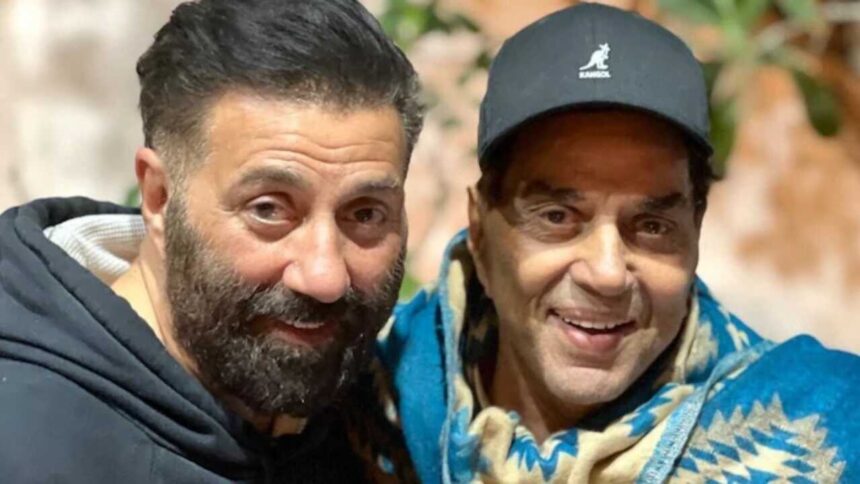
Sunny Deol, the renowned Bollywood actor, has been making headlines lately for his upcoming film ‘Batwara 1947’. While promoting the movie, Deol was posed with a question that could have sparked a controversy – his views on Pakistan. However, the actor chose to tread carefully, avoiding any statement that could be perceived as politically charged. Instead, he reminisced about his father, the legendary actor Dharmendra, who had once affectionately referred to Pakistan as his ‘mausi’ (maternal aunt), leaving the audience in a state of nostalgia and admiration for the veteran actor’s wit.
Recalling the Past
The remark made by Dharmendra has been etched in the memories of many, and Sunny Deol’s reference to it served as a reminder of the complex and often delicate relationship between India and Pakistan. The elder Deol’s statement, ‘Pakistan meri mausi hai’, was a reflection of the cultural and historical ties that bind the two nations, despite their differences. By invoking this memory, Sunny Deol steered the conversation towards a more neutral and respectful terrain, acknowledging the shared heritage of the two countries without taking a political stance.
The decision to recall his father’s words was likely a strategic one, considering the sensitive nature of the topic. As an actor and a public figure, Sunny Deol is well aware of the impact his words can have on his fans and the wider audience. By choosing to focus on the cultural aspect of the relationship between India and Pakistan, he was able to promote his film while avoiding any potential controversy that could have arisen from making a political statement.
The Film and Its Significance
‘Batwara 1947’ is a film that explores the tumultuous period of India’s partition, a time of great upheaval and transformation for the nation. The movie’s themes of love, loss, and resilience are likely to resonate with audiences, and Sunny Deol’s involvement in the project has generated a significant amount of interest and anticipation. As the release date approaches, the actor’s promotional efforts have been geared towards highlighting the film’s emotional and historical significance, rather than courting controversy or making provocative statements.
The film’s narrative is expected to be a powerful exploration of the human cost of partition, and the ways in which it affected individuals and communities on both sides of the border. By focusing on the personal stories and struggles of those who lived through this period, ‘Batwara 1947’ aims to provide a nuanced and empathetic portrayal of a complex and often painful chapter in Indian history. Sunny Deol’s involvement in the project is a testament to his commitment to telling stories that matter, and his ability to connect with audiences on a deep and emotional level.
Avoiding Controversy
Sunny Deol’s decision to avoid making a political statement about Pakistan is a reflection of the changing landscape of Bollywood and the Indian film industry. In recent years, there has been a growing trend towards more nuanced and thoughtful storytelling, with many films exploring complex social and political issues in a sensitive and respectful manner. By steering clear of controversy, Deol is able to promote his film and connect with his audience without alienating or offending any particular group or community.
The actor’s approach is also a testament to the enduring power of cinema to bring people together and transcend borders. Despite the many differences that exist between India and Pakistan, the shared love of film and music has long been a source of common ground and cultural exchange between the two nations. By focusing on the universal themes and emotions that underpin ‘Batwara 1947’, Sunny Deol is able to promote a message of unity and understanding, one that transcends the boundaries of politics and nationality.