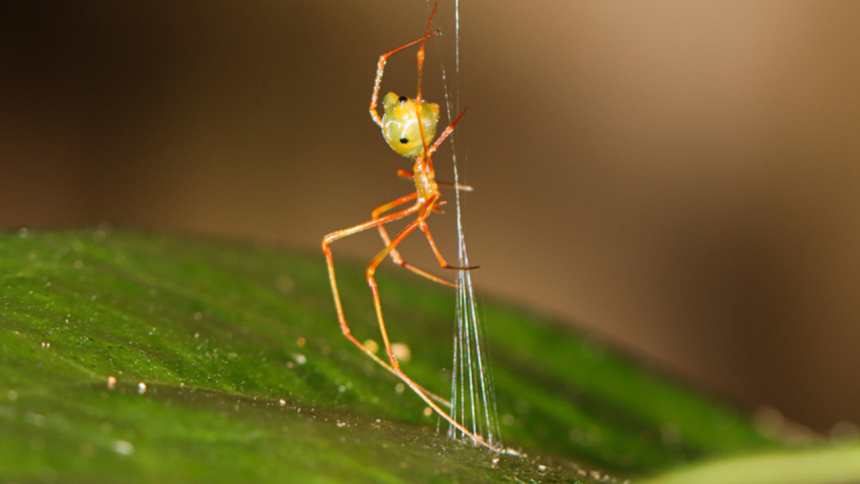
Deep in the rainforests of far north Queensland, Australia, a tiny but formidable hunter has been discovered, leaving scientists in awe of its extraordinary hunting strategy. The newly described species, nicknamed the ‘ballista spider’, has evolved a unique silk-powered trap that launches prey into its web with accelerations reaching up to 140 times the force of gravity, making it one of the most impressive examples of evolutionary adaptability in the natural world. This remarkable arachnid has sparked intense interest among researchers, who are eager to unravel the secrets behind its remarkable hunting prowess.
The Ballista Spider’s Deadly Mechanism
The ballista spider’s hunting strategy relies on a sophisticated mechanism that involves the use of silk threads to create a trap that can be triggered with incredible force. When an unsuspecting ant or other small insect wanders into the spider’s web, it triggers a mechanism that releases the stored energy in the silk threads, catapulting the prey into the air and straight into the spider’s waiting jaws. This mechanism is so powerful that it can accelerate the prey to speeds of up to 1.2 meters per second in just 0.1 milliseconds, making it one of the fastest and most powerful movements in the animal kingdom.
Researchers have been studying the ballista spider’s mechanism in detail, using high-speed cameras and other advanced technologies to understand the intricacies of its hunting strategy. By analyzing the spider’s web and the movement of its prey, scientists have been able to gain a deeper understanding of the physics behind the ballista spider’s remarkable abilities, and how it is able to generate such incredible forces relative to its tiny size.
Evolutionary Adaptations and Implications
The ballista spider’s unique hunting strategy is a testament to the incredible diversity of evolutionary adaptations in the natural world. The development of such a complex and powerful mechanism is likely to have been driven by the spider’s need to compete with other predators in its environment, and to catch prey in a highly competitive and rapidly changing ecosystem. The study of the ballista spider’s mechanism has also implications for our understanding of the evolution of other complex traits in animals, and how these traits are adapted to specific environments and ecological niches.
Furthermore, the discovery of the ballista spider’s mechanism has also sparked interest in the potential applications of its technology in other fields, such as materials science and engineering. The development of new materials and technologies that can mimic the properties of the ballista spider’s silk threads could have significant implications for a wide range of industries, from textiles to aerospace engineering. As researchers continue to study the ballista spider and its remarkable abilities, it is likely that we will uncover even more secrets and surprises from this tiny but deadly hunter.
Conservation and Future Research
The discovery of the ballista spider has also highlighted the importance of preserving and protecting the world’s rainforests, which are home to a vast array of unique and fascinating species. The ballista spider is just one example of the many incredible animals that can be found in these ecosystems, and its discovery serves as a reminder of the need to conserve and protect these environments for future generations. As researchers continue to study the ballista spider and its habitat, it is likely that we will uncover even more secrets and surprises from this incredible ecosystem.
The study of the ballista spider is an ongoing process, and researchers are eager to continue exploring the secrets of this incredible arachnid. With its unique hunting strategy and powerful mechanism, the ballista spider is a fascinating subject that is sure to continue to inspire scientific inquiry and wonder. As we continue to learn more about this tiny but deadly hunter, we are reminded of the incredible diversity and complexity of the natural world, and the many secrets that remain to be uncovered.