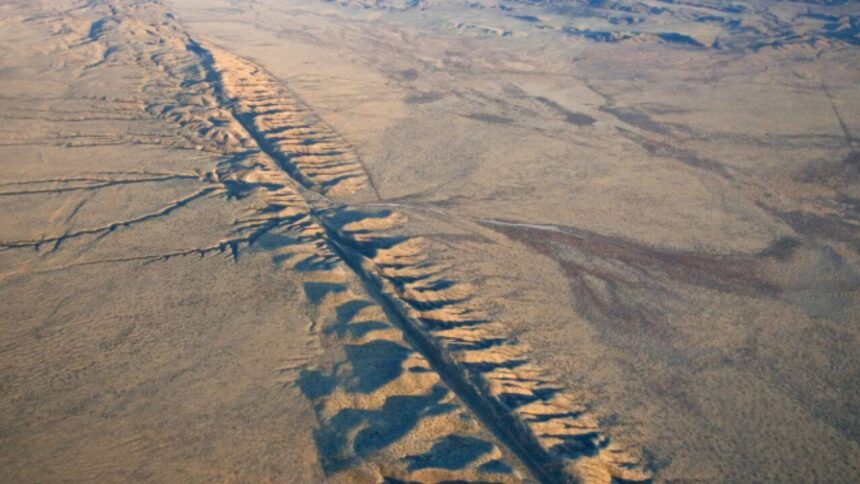
The San Andreas Fault, one of the most feared and studied fault lines in the world, has long been the subject of scientists’ curiosity and concern. Stretching over 800 miles, this complex network of tectonic plates has been responsible for some of the most devastating earthquakes in California’s history. But recent breakthroughs in artificial intelligence have led researchers to a hidden world beneath the surface, where slow movements and silent slip have been detected, challenging previous assumptions about the fault’s behavior.
Uncovering the Hidden Slip
A team of researchers, armed with the power of artificial intelligence, has made a groundbreaking discovery that could change the way we understand earthquake activity. By analyzing vast amounts of seismic data, the AI system identified a type of slow fault slip that had largely gone unnoticed until now. This phenomenon, known as ‘silently slipping’ or ‘aseismic slip,’ occurs when the Earth’s crust moves slowly, without the characteristic shaking and rumbling of a traditional earthquake.
The researchers used a combination of machine learning algorithms and traditional seismic data to detect the hidden slip. They analyzed data from a network of seismometers and GPS sensors that track the movement of the Earth’s crust. The AI system was able to identify patterns and anomalies in the data that hinted at the presence of silent slip.
The discovery is significant because it suggests that silent slip may play a more significant role in earthquake activity than previously thought. The researchers found that the silent slip events were often followed by small earthquakes, which could be a sign that the stress was building up and eventually leading to a more significant seismic event.
The Potential for a Massive Earthquake
The implications of this discovery are far-reaching. If silent slip is indeed a key factor in earthquake activity, it could mean that scientists have been underestimating the risk of a massive earthquake. The San Andreas Fault is long overdue for a major earthquake, and the discovery of silent slip adds a new layer of complexity to the equation.
The researchers stress that the silent slip events are not a precursor to the ‘Big One,’ but rather a natural process that has been occurring for millions of years. However, the fact that these events are often followed by small earthquakes suggests that there may be a relationship between the two.
The team is now working to refine their models and better understand the mechanisms behind silent slip. They hope to develop new tools and techniques that will allow them to predict when and where a massive earthquake is likely to occur.
The Future of Earthquake Prediction
The San Andreas Fault is a ticking time bomb, and scientists are working tirelessly to understand its behavior. The discovery of silent slip is a significant step forward in this effort, and it highlights the importance of artificial intelligence in the field of earthquake research.
The use of AI in earthquake research is still in its infancy, but it has the potential to revolutionize the way we predict and prepare for seismic events. By analyzing vast amounts of data and identifying patterns that would be impossible for humans to detect, AI can help scientists develop more accurate models and forecasts.
The future of earthquake prediction is bright, and the discovery of silent slip is a major milestone on this journey. As scientists continue to push the boundaries of what is possible, we may finally be able to unlock the secrets of the San Andreas Fault and prepare for the inevitable seismic event that will shape the future of California.
The discovery of silent slip is a reminder that the Earth’s crust is a complex and dynamic system, and that there is still much to be learned about its behavior. As we continue to explore and understand the mysteries of the San Andreas Fault, we may uncover new and unexpected ways to mitigate the risks of earthquake activity.
The journey to understanding the San Andreas Fault is far from over, but with the help of AI, scientists are making significant strides in their quest to unlock its secrets.