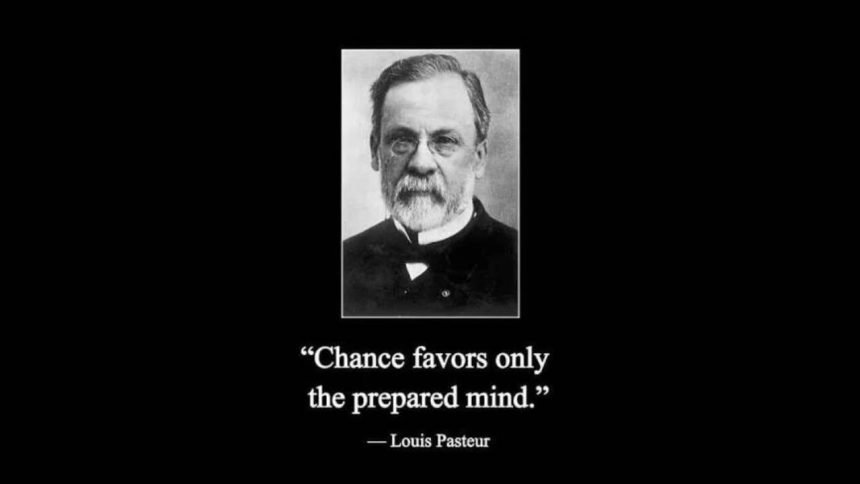
The age-old adage ‘Chance favours the prepared mind’ has been a guiding principle for scientists for centuries. It suggests that success in research often lies not in the luck of an unplanned accident, but in the readiness to capitalise on the opportunities that it presents. This notion was first proposed by the 19th-century French chemist and microbiologist Louis Pasteur, who himself embodied the spirit of preparedness in his groundbreaking work on vaccination and germ theory. In a laboratory setting, the potential for serendipitous discoveries is ever-present. Yet, two scientists working on the same project can stumble into the same unplanned accident and respond to it in vastly different ways.
Stumbling into Serendipity
Consider the experience of Alexander Fleming, the Scottish scientist credited with the discovery of penicillin. In 1928, Fleming returned to his laboratory after a two-week holiday to find that one of his bacterial cultures had been contaminated by a mould. Initially, he was disappointed to have ruined an experiment, but as he examined the culture more closely, he noticed that the mould had killed off the surrounding bacteria. This chance observation led to the development of penicillin as an antibiotic.
However, not all scientists are as fortunate in their response to unplanned accidents. Many may discard the results, dismissing them as a mistake, and start again from scratch. This approach can be a result of fear, a lack of confidence in their research, or simply a lack of experience in navigating the unpredictable world of scientific inquiry. The prepared mind, on the other hand, is one that is open to new possibilities, able to think creatively and critically, and willing to take calculated risks.
The Role of Preparation in Scientific Discovery
Preparation is not just about having the right equipment and resources; it is also about cultivating a mindset that is receptive to the unexpected. This involves developing a deep understanding of the research question, staying up-to-date with the latest developments in the field, and being willing to challenge assumptions and conventional wisdom. It also requires a high degree of self-awareness, allowing scientists to acknowledge their own biases and limitations.
One notable example of preparedness in action is the story of Rosalind Franklin, a British biophysicist who made significant contributions to our understanding of the structure of DNA. Her work on the X-ray crystallography of DNA led to the development of the famous ‘photograph 51’, which provided crucial evidence for James Watson and Francis Crick’s double helix model. However, Franklin’s own research was often overshadowed by that of her colleagues, a testament to the fact that even the most prepared minds can sometimes be overlooked.
The Value of Preparation in the Modern Era
Today, the pace of scientific progress is faster than ever, with new breakthroughs and discoveries being announced on a regular basis. In this environment, the prepared mind is more essential than ever, as scientists face increasing pressure to publish results, secure funding, and meet the expectations of their peers. However, the value of preparation extends beyond the scientific community, as it has the potential to benefit society as a whole.
By cultivating a culture of preparedness and open-mindedness, we can foster a more collaborative and innovative approach to research, one that is better equipped to tackle the complex challenges of the 21st century. This may involve embracing unconventional thinking, taking calculated risks, and being willing to challenge established norms. As Pasteur’s quote suggests, chance may favour the prepared mind, but it is the prepared mind that ultimately holds the key to unlocking the secrets of the universe.
The next time an unplanned accident occurs in a laboratory, let us not dismiss it as a mistake, but as an opportunity to capitalise on the unexpected. By embracing the prepared mind, we can unlock the full potential of scientific inquiry and continue to push the boundaries of human knowledge.